

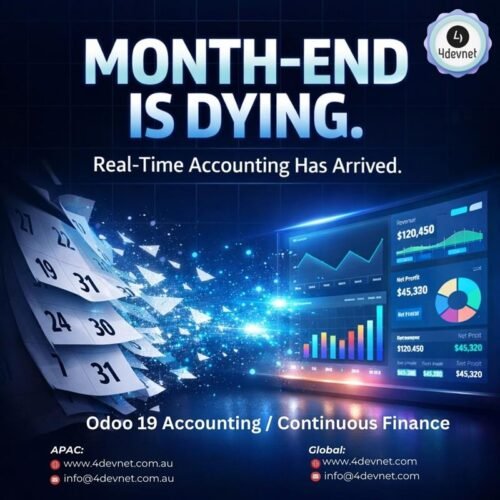
Real-Time Accounting with Odoo 19: Why Month-End Closing Is Becoming Obsolete
Introduction: A Shift in Financial Thinking
For decades, organizations have structured their financial operations around a single recurring process — month-end closing. Finance teams gather transactions, reconcile accounts, correct discrepancies, and finally produce reports that describe what has already happened.
While this model worked in slower business environments, today’s organizations operate in real time. Sales transactions occur instantly, supply chains move continuously, and leadership decisions must be based on current financial reality rather than historical summaries.
Modern ERP platforms such as Odoo are transforming accounting from a periodic reporting function into a continuous financial management system.
The Limitations of Traditional Month-End Closing
Traditional accounting workflows were built around disconnected systems. Sales, inventory, purchasing, and banking data often existed in separate applications, forcing accounting teams to manually consolidate information at the end of each reporting period.
This approach introduces several operational challenges:
- Delayed financial visibility
- Time-consuming reconciliations
- Increased risk of manual errors
- Limited forecasting accuracy
- Decision-making based on outdated data
As businesses grow more dynamic, relying on month-old financial insight creates strategic disadvantages.
Why Real-Time Accounting Is Becoming Essential
Modern organizations require financial intelligence that evolves alongside daily operations. Executives increasingly need answers to questions such as:
- What is our current cash position?
- Which products are profitable today?
- Where are financial risks emerging right now?
Real-time accounting addresses these needs by ensuring financial records update automatically as business transactions occur. Instead of preparing reports after the fact, companies operate with continuously updated financial information.
How Odoo 19 Enables Continuous Accounting
Odoo 19 introduces an integrated ERP accounting framework where operational activities and financial records function within a single ecosystem. This integration eliminates delays between business actions and financial reporting.
1. Automatic Financial Posting
Every operational transaction — sales orders, purchase activities, inventory movements, and payments — generates accounting entries automatically. Financial data remains synchronized without manual intervention.
2. Intelligent Bank Synchronization
Automated bank feeds and reconciliation tools significantly reduce repetitive accounting tasks. Transactions are matched intelligently, allowing finance professionals to focus on review rather than data entry.
3. Unified Business and Financial Data
Unlike standalone accounting software, ERP accounting connects financial performance directly to operational activity. Inventory valuation, procurement costs, and revenue recognition become inherently accurate because they originate from the same system.
4. Real-Time Financial Reporting
Dashboards and reports update continuously, providing immediate visibility into:
- Profit and loss performance
- Cash flow status
- Payables and receivables
- Business unit profitability
This eliminates the traditional waiting period associated with financial reporting cycles.
The Changing Role of Month-End Closing
In a real-time ERP environment, month-end closing does not disappear entirely — but its purpose evolves.
Instead of reconstructing financial records, finance teams perform validation and strategic review. Since transactions are recorded accurately throughout the month, closing becomes faster, simpler, and significantly less stressful.
Organizations experience shorter closing cycles and improved financial confidence.
Transformation of the Finance Function
Automation within modern ERP systems reshapes the role of accounting professionals. Routine administrative tasks decrease, allowing finance teams to contribute more strategically.
The transition includes:
| Traditional Accounting Focus | Modern ERP Finance Role |
| Manual data entry | Financial analysis |
| Error correction | Business advisory |
| Periodic reporting | Continuous forecasting |
| Compliance tracking | Strategic planning |
This evolution enables finance departments to become active contributors to organizational growth.
Business Benefits of Continuous Accounting
Adopting real-time ERP accounting provides measurable organizational advantages:
Faster Decision Making
Leadership teams gain immediate access to reliable financial insights.
Improved Cash Flow Management
Continuous monitoring helps identify liquidity risks early.
Higher Data Accuracy
Automation reduces dependency on manual reconciliation processes.
Scalable Financial Operations
Businesses can expand without proportionally increasing accounting workload.
Why SMEs Gain Significant Advantage
Small and mid-sized businesses traditionally lacked access to advanced financial systems used by large enterprises. Modern ERP platforms bridge this gap by delivering enterprise-level financial visibility within a unified system.
Organizations gain:
- Real-time performance monitoring
- Automated financial workflows
- Integrated operational intelligence
- Better planning and forecasting capabilities
This allows growing businesses to operate with greater financial maturity and control.
The Future of Accounting: Always-Accurate Financials
Accounting is transitioning from retrospective reporting toward proactive financial management. Continuous accounting ensures that financial records remain accurate at all times rather than being corrected periodically.
The objective is no longer to close books faster — it is to maintain books that are effectively always closed.
Conclusion
The evolution of ERP technology is redefining how organizations manage finance. Real-time accounting powered by Odoo 19 replaces delayed reporting with continuous visibility, enabling smarter decisions and stronger financial governance.
Businesses that adopt this approach move beyond operational accounting and toward strategic financial leadership.
The real question is no longer how quickly you can close the month — but whether your financial data is already ready when decisions need to be made.