

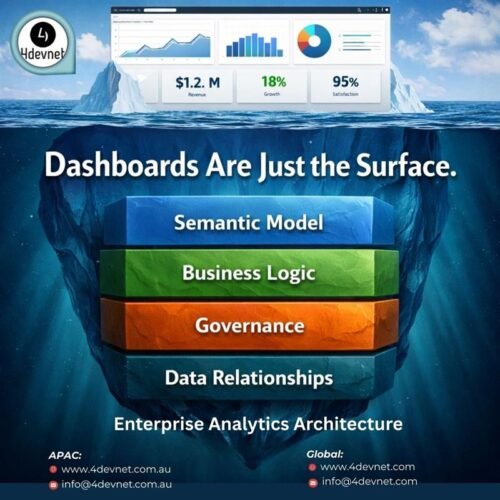
Beyond Visualization: The Real Foundation of Modern Power BI Analytics
Introduction: Why Dashboards Alone Don’t Create Data-Driven Organizations
Many businesses invest in dashboards expecting instant visibility and smarter decision-making. Reports look modern, KPIs are displayed clearly, and leadership assumes analytics transformation is complete.
However, after initial adoption, common challenges emerge:
- Different departments report conflicting numbers
- Executives question data accuracy
- Teams rely on manual spreadsheets for validation
- Reports become difficult to maintain
These problems are rarely caused by the analytics tool itself.
In most cases, organizations are using Microsoft Power BI only as a reporting interface rather than as a structured enterprise analytics platform.
Dashboards show results — but architecture creates trust.
The Evolution of Business Intelligence
Traditional business intelligence focused on historical reporting — answering what already happened.
Modern enterprises require analytics that can:
- Provide consistent KPIs across departments
- Deliver near real-time operational insights
- Support strategic planning and forecasting
- Enable confident executive decisions
This evolution shifts Power BI from a visualization tool into a decision-support ecosystem.
Organizations achieving real ROI focus first on data structure, governance, and modeling before building dashboards.
The Hidden Layer Behind Successful Power BI Implementations
High-performing analytics environments rely on a foundation that users rarely see. This hidden layer ensures accuracy, scalability, and long-term usability.
1. Semantic Models: Establishing a Single Version of Truth
A semantic model standardizes business definitions across the organization.
Instead of each department calculating metrics differently, KPIs are defined once and reused everywhere.
Examples include:
- Revenue calculation standards
- Profitability formulas
- Inventory valuation methods
- Operational performance indicators
This eliminates reporting conflicts and builds organizational confidence in analytics.
2. Centralized Business Logic
One of the most common implementation mistakes is embedding calculations directly inside individual reports.
This approach creates duplication and inconsistency.
Enterprise Power BI environments centralize calculations using reusable measures and shared datasets, enabling:
- Faster report development
- Easier maintenance
- Consistent analytical outcomes
3. Data Governance and Security
Analytics adoption depends heavily on trust. Governance ensures that users rely on dashboards without questioning data accuracy.
Key governance practices include:
- Certified and approved datasets
- Role-based access control
- Data lineage visibility
- Controlled KPI definitions
When governance is implemented correctly, analytics becomes a reliable decision platform rather than just a reporting tool.
4. Optimized Data Modeling for Performance
Raw operational data is rarely structured for analytics. Proper modeling transforms complex datasets into business-friendly structures.
Best practices include:
- Star schema data modeling
- Clean dimension and fact tables
- Optimized relationships
- Performance tuning for large datasets
Well-designed models improve dashboard speed while supporting enterprise-scale growth.
Why Many Power BI Dashboards Fail Executives
Despite heavy investments, many dashboards fail to deliver measurable business value.
Common reasons include:
- Too many visuals without clear priorities
- Multiple KPI definitions across teams
- Independent report creation by departments
- Lack of centralized architecture
Executives do not need more charts — they need clarity and consistency.
When architecture is weak, dashboards create confusion.
When architecture is strong, dashboards enable confident decisions.
Business Benefits of Enterprise Power BI Architecture
Organizations that invest in structured analytics foundations experience significant advantages:
✅ Unified reporting across departments
✅ Faster executive decision-making
✅ Reduced manual reporting effort
✅ Improved operational visibility
✅ Scalable analytics adoption
✅ Higher trust in business data
Instead of managing disconnected reports, companies operate from a centralized analytics ecosystem.
Why Professional Power BI Consulting Matters
Many internal teams successfully create dashboards but struggle to design scalable analytics architecture.
A professional implementation partner helps organizations:
- Design enterprise data architecture
- Define KPI governance frameworks
- Integrate ERP, CRM, and operational systems
- Optimize performance and scalability
- Prepare analytics environments for AI-driven insights
Within the broader ecosystem developed by Microsoft, Power BI integrates deeply with cloud platforms, automation tools, and advanced analytics services. Proper architectural planning ensures businesses can leverage these capabilities in the future.
Industries Benefiting from Advanced Power BI Solutions
Enterprise analytics architecture delivers strong results across industries such as:
- Manufacturing and Supply Chain
- Retail and FMCG
- Logistics and Distribution
- Healthcare and Hospital Management
- Construction and Project Operations
- Financial and Operational Analytics
Each industry requires standardized metrics and governed reporting to support strategic growth.
Signs Your Organization Needs Power BI Architecture Modernization
Your analytics environment may require improvement if:
- Meetings focus on validating numbers instead of decisions
- Reports show inconsistent KPIs
- Dashboard performance declines as data grows
- Teams maintain multiple versions of reports
- Manual reporting processes still exist
These challenges indicate architectural gaps rather than visualization issues.
Building a Future-Ready Analytics Foundation
Organizations aiming for long-term analytics success should focus on:
- Designing centralized semantic models
- Standardizing enterprise KPI definitions
- Implementing governance and security frameworks
- Separating data modeling from report design
- Continuously optimizing performance
The objective is not creating more dashboards — but creating trusted analytics systems.
Conclusion: Dashboards Are Only the Beginning
Dashboards capture attention because they are visible.
Architecture delivers value because it builds reliability.
Organizations that treat Power BI as a reporting tool achieve limited results. Those that invest in data architecture create scalable competitive advantage.
The real question for modern businesses is no longer:
How many dashboards do we have?
It is:
Do we have a single, trusted definition of our business data?