

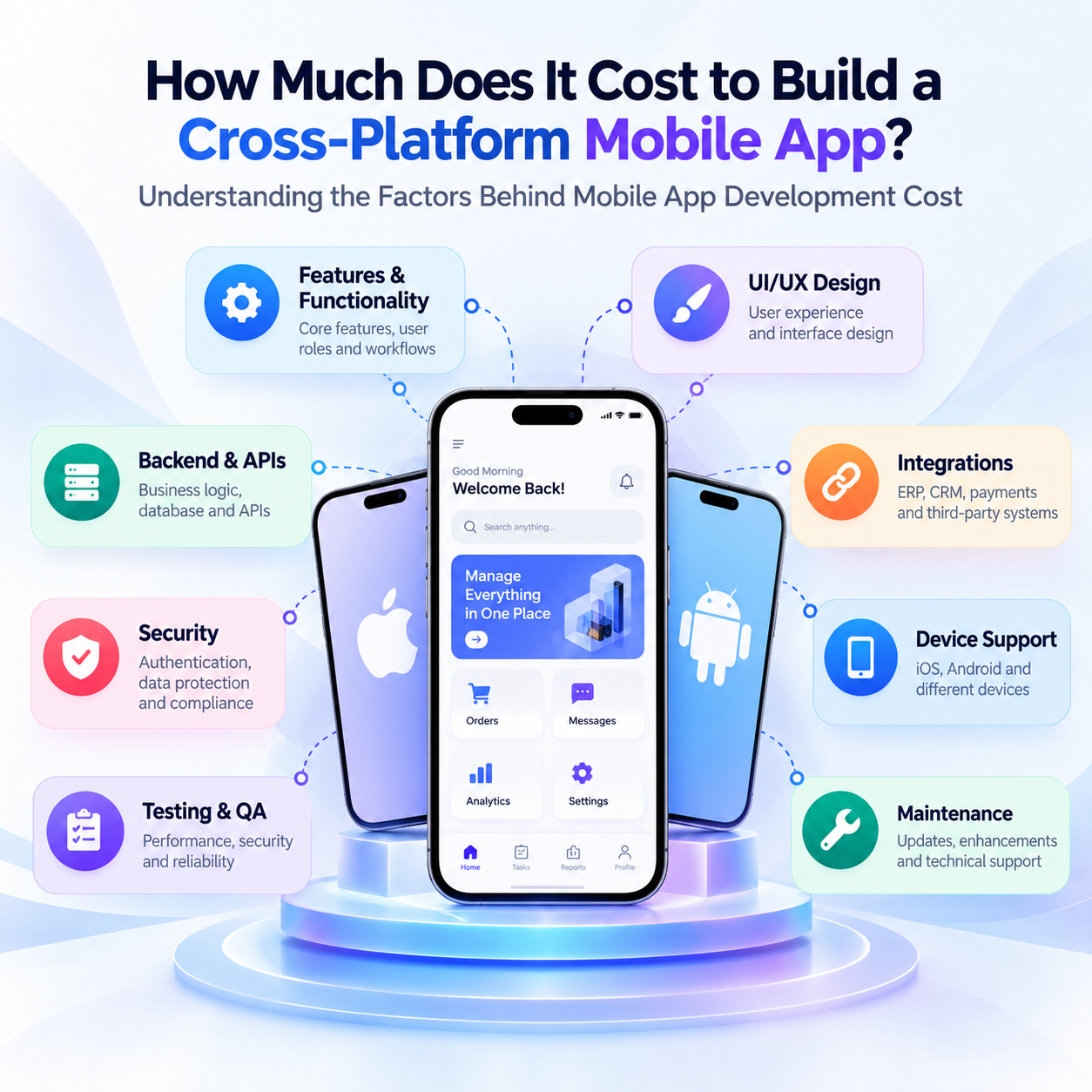
How Much Does It Cost to Build a Cross-Platform Mobile App?
Building a mobile app for both iOS and Android can be an important step for a growing business. Whether you are developing a customer-facing application, an employee app, an e-commerce platform, a field service solution, or a new digital product, one of the first questions that comes up is:
How much does it cost to build a cross-platform mobile app?
The answer depends on the application you want to build.
There is no universal cost for mobile app development because every application has different requirements. The number of features, user types, design complexity, backend architecture, integrations, security requirements, device support, testing, and post-launch maintenance can all influence the overall project investment.
Cross-platform development can be an effective approach for businesses that want to reach both iOS and Android users without maintaining completely separate application development projects. However, choosing a cross-platform approach does not automatically determine the cost.
The more important question is:
What does your mobile application need to accomplish?
This guide explains the key factors that influence cross-platform mobile app development cost, how to plan your budget, what is typically included in a mobile app project, and how to choose the right development partner.
Is There a Fixed Cost for Cross-Platform Mobile App Development?
No.
A professional mobile app development company should estimate a project based on its requirements rather than offering one standard price for every application.
Consider two examples.
A simple business application may only require:
- Secure login
- User profile
- Dashboard
- Basic forms
- Notifications
A more advanced application could require:
- Multiple user roles
- Real-time information
- Online payments
- GPS and location services
- Push notifications
- Chat
- Document management
- ERP or CRM integration
- Offline functionality
- Advanced reporting
Both applications can be developed for iOS and Android, but their development effort will be very different.
This is why an accurate mobile app development cost estimate should be based on the application’s scope, user requirements, technical architecture, and integrations.
What Determines the Cost of a Cross-Platform Mobile App?
Several factors contribute to the overall cost of developing a cross-platform mobile application.
Understanding these factors before starting development can help you create a more realistic budget and avoid unexpected scope changes.
1. Type and Purpose of the Mobile App
The type of application you are building is one of the biggest influences on development effort.
Business and Employee Applications
Businesses often build mobile applications to help employees access information and complete workflows while working from the office, remotely, or in the field.
Examples include:
- Sales applications
- Employee applications
- Approval systems
- Inventory applications
- Field service applications
- Internal workflow applications
- Reporting and dashboard applications
These applications may need authentication, role-based access, forms, notifications, and integration with existing business systems.
Customer Applications
A customer-facing mobile application may allow users to:
- Create and manage their accounts
- Place orders
- Make payments
- Submit service requests
- Access documents
- Track activities
- Receive notifications
- Communicate with support teams
Because the application directly interacts with customers, usability, performance, reliability, and security become particularly important.
E-commerce Mobile Apps
An e-commerce application can involve considerably more functionality than a basic business app.
Typical features include:
- Product catalog
- Search and filtering
- Shopping cart
- Checkout
- Payment gateway
- Customer accounts
- Order tracking
- Promotions
- Inventory integration
- Shipping integration
- Push notifications
The number of products, business rules, integrations, and customer workflows can significantly influence development effort.
On-Demand and Service Applications
Applications for delivery, transportation, home services, field operations, or similar businesses may require:
- GPS
- Location tracking
- Service assignment
- Real-time status
- Customer notifications
- Scheduling
- Maps
- Multiple user roles
These requirements can introduce additional backend, API, and real-time communication complexity.
SaaS and Business Platforms
A mobile application that works as part of a SaaS platform may need subscription management, multiple organizations, advanced permissions, dashboards, user management, notifications, and synchronization with a web application.
The business purpose and application architecture should therefore be defined before estimating development costs.
2. Features and Functional Requirements
The features you want to provide are another major factor in cross-platform app development cost.
A small application with five or six screens may be relatively straightforward compared with a platform containing dozens of workflows.
Common mobile application features include:
- User registration and authentication
- User profiles
- Dashboards
- Search and filtering
- Forms
- File uploads
- Push notifications
- Online payments
- Chat and messaging
- GPS and location services
- Camera integration
- Document management
- Reports
- Social login
- Offline access
- Multi-language support
Each additional feature may require frontend development, backend logic, database changes, API development, testing, and security considerations.
A practical approach is to divide features into three groups.
Core Features
These are essential for the first version of the application.
Secondary Features
These improve the user experience or add additional business value but may not be essential for the initial launch.
Future Features
These can be introduced as the product gains users and the business requirements evolve.
This approach allows businesses to launch an effective first version without trying to build every planned feature at once.
3. Mobile UI/UX Design
A successful mobile application is not only about functionality. Users also expect the application to be intuitive, responsive, and easy to navigate.
The design requirements can therefore influence the overall development effort.
A professional mobile UI/UX process may include:
- User research
- User journey mapping
- Information architecture
- Wireframes
- Interactive prototypes
- Custom interface design
- Navigation design
- Design systems
- Accessibility considerations
- Usability testing
The application may also need to accommodate different screen sizes and device characteristics.
For customer-facing applications, investing in a well-planned user experience can have a direct impact on adoption, engagement, and customer satisfaction.
4. Backend, APIs, and Database
The mobile application is usually only one component of the complete solution.
Most business applications require backend services to manage:
- User accounts
- Authentication
- Business rules
- Databases
- APIs
- Permissions
- Notifications
- File storage
- Payments
- Data synchronization
If your business already has a backend and well-documented APIs, the mobile development project may primarily focus on the mobile experience and API integration.
If the application is being developed from the ground up, the project may require:
Mobile Application + Backend + Database + APIs + Administration Portal
This broader scope can substantially affect the overall development cost.
Before starting development, it is therefore important to determine whether the mobile app will connect to an existing system or require a complete backend solution.
5. Integration With ERP, CRM, and Other Systems
Many businesses need their mobile application to work with systems they already use.
For example, a sales application may need access to customer, product, inventory, and order information stored in an ERP or CRM system.
Common integrations include:
- ERP systems
- CRM platforms
- Accounting software
- Payment gateways
- E-commerce platforms
- Shipping services
- Email platforms
- SMS providers
- Authentication services
- Maps and location services
- Third-party APIs
- Business intelligence platforms
A typical business architecture could look like:
Mobile App → API Layer → ERP / CRM / Business System
The complexity of an integration depends on factors such as:
- API availability
- Authentication requirements
- Data structures
- Data synchronization
- Business rules
- Number of connected systems
- Frequency of data exchange
Integrations should be identified during the planning stage because late integration requirements can affect both architecture and timelines.
6. Device Features and Platform Requirements
One of the key benefits of cross-platform mobile development is the ability to target multiple platforms through a shared development approach.
However, mobile applications still need to work reliably across different devices and operating system versions.
Depending on the application, you may need access to:
- Camera
- GPS
- Bluetooth
- Push notifications
- File storage
- Biometrics
- Contacts
- Location services
- Device permissions
The more device-specific capabilities your application uses, the more development and testing may be required.
Businesses should therefore identify which device capabilities are essential before development begins.
7. Offline Functionality and Synchronization
Some applications need to remain useful when users have limited or no internet connectivity.
This is particularly relevant for:
- Field service applications
- Sales applications
- Delivery applications
- Inventory applications
- Remote workforce applications
An offline-enabled application may need to store information locally and synchronize it with the server when connectivity is restored.
For example:
Mobile App → Local Storage → Connection Restored → Data Synchronization → Server
This requires additional architecture, synchronization rules, conflict handling, and testing.
If offline functionality is important to your business, it should be considered from the beginning rather than added later.
8. Security and Data Protection
Security requirements can significantly influence mobile app development effort.
This becomes particularly important when an application handles customer information, employee data, financial transactions, or confidential business information.
Depending on the application, security requirements may include:
- Secure authentication
- Password recovery
- Multi-factor authentication
- Role-based permissions
- Biometric authentication
- Secure API communication
- Data encryption
- Session management
- Audit trails
- Access restrictions
Security should be incorporated into the application architecture from the beginning.
Addressing security requirements late in the development process can lead to redesign, additional testing, and increased project effort.
9. Testing and Quality Assurance
Testing is an essential part of professional mobile application development.
A cross-platform application should be tested across the devices and operating systems relevant to its target users.
Testing may include:
- Functional testing
- API testing
- Integration testing
- Device testing
- Screen-size testing
- Cross-platform testing
- Performance testing
- Security testing
- Usability testing
- Regression testing
- User acceptance testing
Testing requirements can increase with the number of supported devices, operating system versions, integrations, and application workflows.
A strong QA process helps identify problems before they affect users in production.
What Does a Mobile App Development Budget Usually Include?
When comparing mobile app development proposals, businesses should consider the complete development lifecycle, not only coding hours.
A typical project may include the following stages.
Discovery and Requirements
Understanding the business objectives, target users, workflows, features, integrations, and technical requirements.
UI/UX Design
Creating user journeys, wireframes, prototypes, and the final mobile application interface.
Mobile App Development
Developing the application for the required platforms using an appropriate cross-platform technology.
Backend Development
Building APIs, business logic, databases, authentication, and supporting services where required.
Administration Portal
Many business applications require a web-based admin panel for managing users, content, transactions, reports, or workflows.
Integrations
Connecting the application with ERP, CRM, payment gateways, third-party APIs, and other business systems.
Testing and QA
Testing functionality, devices, integrations, security, performance, and usability.
Deployment
Preparing the application for production and configuring the required infrastructure and release process.
Maintenance and Support
Providing bug fixes, application updates, security improvements, performance optimization, enhancements, and technical support after launch.
When comparing proposals, always check what is included and what is excluded.
A lower initial quote may not necessarily represent a lower overall project investment if important services are excluded.
How Can You Control Cross-Platform Mobile App Development Costs?
A controlled budget does not necessarily mean removing valuable features.
Better planning can often make a much bigger difference.
Build an MVP First
An MVP, or Minimum Viable Product, contains the core functionality required to launch and validate the product.
For example, an initial release could include:
- User registration
- Secure login
- Core business workflow
- Dashboard
- Essential notifications
Additional functionality can be introduced based on actual user feedback.
Define Requirements Before Development
Unclear requirements often lead to:
Scope Changes → Rework → Delays → Higher Development Costs
A clear requirements document gives both the business and development team a common understanding of what needs to be delivered.
Identify Integrations Early
If your application needs to communicate with an ERP, CRM, payment gateway, or external API, identify these requirements during project planning.
Prioritize Business-Critical Features
Not every feature needs to be part of version one.
Prioritize functionality according to:
- Business value
- User importance
- Revenue impact
- Operational efficiency
- Regulatory requirements
Choose Technology Based on the Product
The most popular technology is not necessarily the best choice for every application.
Technology selection should consider:
- Target platforms
- Application functionality
- Device capabilities
- Performance requirements
- Existing systems
- Development roadmap
- Long-term maintenance
How Long Does It Take to Build a Cross-Platform Mobile App?
The development timeline depends on the scope, complexity, and technical requirements of the application.
As a broad planning reference:
Application Type | Possible Development Timeline |
Basic mobile application | 2–4 months |
Medium-complexity application | 4–6 months |
Advanced business or SaaS application | 6–12+ months |
Complex enterprise application | 9–18+ months |
These are general planning ranges and should not be treated as guaranteed delivery schedules.
The actual timeline may depend on:
- Number of features
- UI/UX requirements
- Backend development
- API integrations
- Device capabilities
- Offline functionality
- Testing requirements
- Team size
- Feedback cycles
- Scope changes
- Deployment requirements
A structured discovery process can provide a much more reliable project timeline.
Cross-Platform Mobile App vs Native App Development
Businesses considering mobile development often ask whether they should build separate native applications for iOS and Android or use a cross-platform approach.
There is no universal answer.
Cross-platform development can be a strong option when:
- Both iOS and Android are required
- Much of the functionality is shared between platforms
- A consistent user experience is important
- Development efficiency is a priority
- The application does not depend heavily on specialized platform-specific functionality
Native development may be preferable when an application relies extensively on platform-specific capabilities or requires highly specialized native performance.
The decision should therefore be based on the business requirements, user expectations, technical architecture, and long-term product roadmap.
How to Choose the Right Mobile App Development Company
Selecting a development partner is an important decision because the quality of the development process can affect the application’s long-term success.
Don’t evaluate companies based on price alone.
Consider the following factors.
Relevant Project Experience
Ask whether the company has developed applications with similar workflows, users, integrations, or industry requirements.
Full-Stack Capability
A mobile application often depends on backend services, APIs, databases, and administration systems.
Integration Expertise
If the app needs ERP, CRM, payment, or third-party integrations, confirm that the development team has relevant experience.
UI/UX Capability
A technically functional application can still fail if users find it difficult to navigate.
Quality Assurance
Understand how the company approaches device testing, functional testing, performance testing, and release validation.
Post-Launch Support
Mobile applications require ongoing maintenance because operating systems, devices, security requirements, and business needs change over time.
Ask whether the development company can provide:
- Bug fixes
- Security updates
- Performance optimization
- New features
- Technical support
- Application monitoring
Why Choose 4devnet for Cross-Platform Mobile App Development?
At 4devnet, we approach mobile application development by first understanding the business problem, target users, workflows, integrations, and long-term objectives.
Our team can help businesses with:
- Cross-platform mobile app development
- React.js development
- Capacitor-based mobile applications
- Custom mobile application development
- Business and enterprise mobile applications
- Customer and partner applications
- API development and integration
- ERP and CRM integration
- E-commerce applications
- Application modernization
- Backend and web application development
We can support the complete development lifecycle, including requirements analysis, UI/UX design, application development, API integration, testing, deployment, and ongoing support.
Whether you are launching a new mobile product, extending an existing web application to mobile, or creating a mobile solution for your employees and customers, the right development strategy starts with understanding your business requirements.
Get a Custom Cross-Platform Mobile App Development Estimate
There is no universal price for building a cross-platform mobile application.
The overall project investment is influenced by:
Features + UI/UX + Backend + Integrations + Security + Device Support + Testing + Infrastructure + Support
Instead of relying on a generic price, your project should be estimated according to its actual requirements.
If you have a mobile app idea, requirements document, prototype, existing web application, or business process that you want to take to mobile, a development team can assess the requirements and recommend an appropriate technical approach.
Planning to Build a Cross-Platform Mobile App?
Let’s discuss your requirements, target platforms, features, integrations, and product roadmap to determine the right development approach for your business.
Book a Free Consultation