

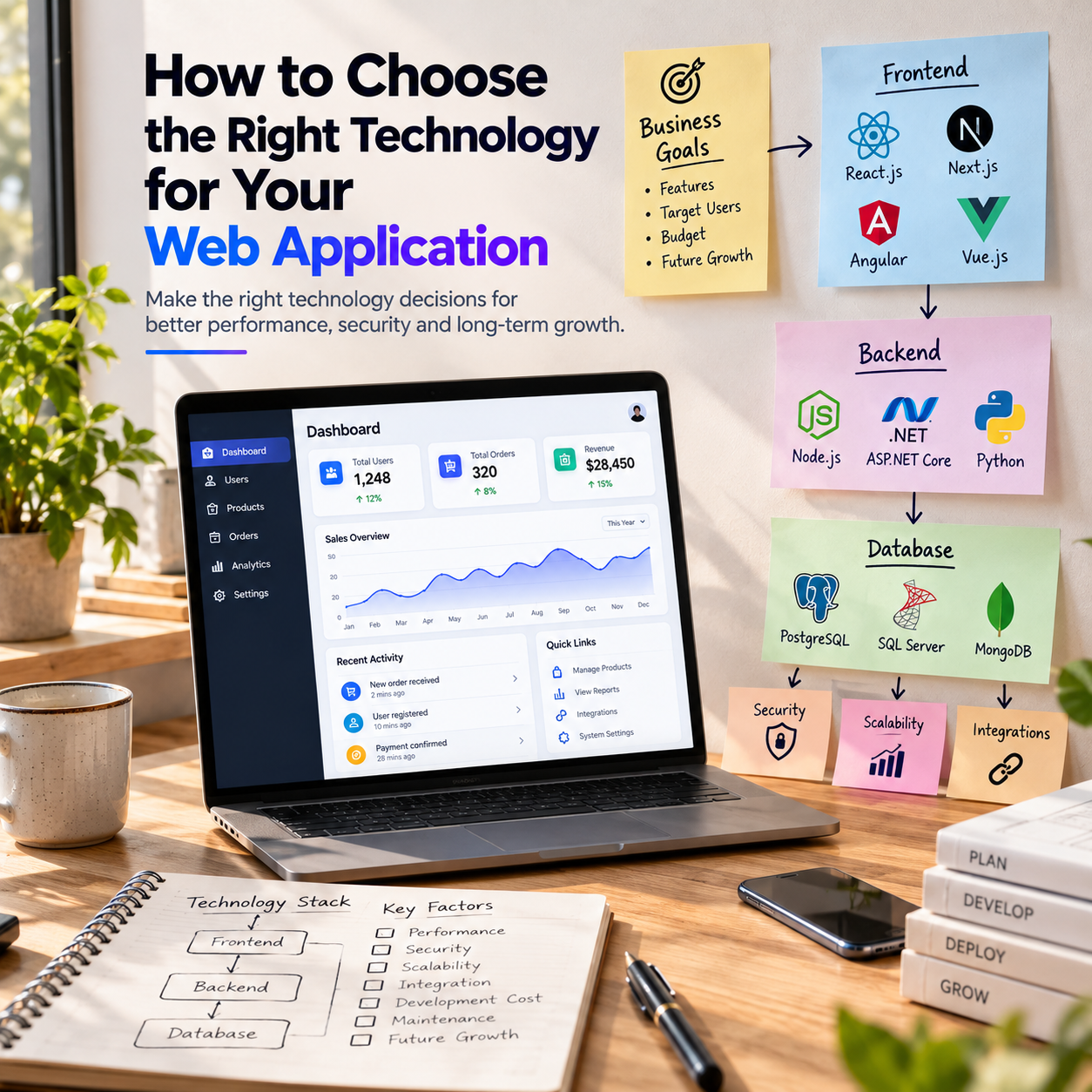
How to Choose the Right Technology Stack for Your Web Application
Choosing the right technology stack is a critical decision when developing a web application. It affects how the application performs, how securely it handles data, how easily it can integrate with existing systems, and how efficiently it can evolve as business requirements change.
With technologies such as React.js, Next.js, Angular, Vue.js, Node.js, ASP.NET Core, Python, and different database platforms available, businesses have many options to consider.
The challenge is not finding the most popular technology. It is identifying the combination of technologies that supports your business objectives without introducing unnecessary complexity or long-term maintenance challenges.
Whether you are planning a customer portal, SaaS platform, e-commerce solution, internal business application, or enterprise system, a well-planned technology stack can provide a strong foundation for development.
In this guide, we explore how to choose the right technology for your web application, the factors that should influence your decision, and the mistakes businesses should avoid.
1. Define Your Business and Application Requirements
Technology selection should begin with a clear understanding of what the application needs to achieve.
A customer-facing website, an employee management portal, and a multi-tenant SaaS platform have different functional and technical requirements. Choosing technologies before defining those requirements can lead to unnecessary development work later.
Start by identifying:
- The business problem the application will solve
- The target users and their expectations
- The essential features and workflows
- Expected user volume and growth
- Required third-party integrations
- Security and compliance needs
- Future product development plans
For example, a customer portal may need secure login, document access, payment processing, and ERP integration. A SaaS platform may additionally require subscription management, tenant isolation, configurable permissions, and administrative controls.
Your requirements should determine the technology—not the other way around.
2. Select the Right Frontend Technology
The frontend is the part of the application that users interact with. It influences the interface, navigation, responsiveness, and overall user experience.
Different frontend technologies serve different purposes.
React.js
React.js is well suited to interactive interfaces, business dashboards, customer portals, and applications that benefit from reusable UI components.
It can be a strong choice for businesses building custom web applications with complex user interactions.
Next.js
Next.js extends React with capabilities such as server rendering, static generation, and structured routing.
It is particularly worth evaluating for public-facing websites and web applications where search visibility, page rendering, and performance are important considerations.
Angular
Angular offers a comprehensive framework with established conventions and built-in development capabilities. It may be suitable for larger applications where consistency across a development team is important.
Vue.js
Vue.js provides a flexible approach to building interactive interfaces and can be appropriate for projects where its ecosystem, development model, and team expertise align with the requirements.
How do you choose? Compare the application requirements, SEO needs, existing codebase, team experience, and long-term maintenance implications. No frontend framework is the best option for every project.
3. Choose a Backend Technology That Fits Your Architecture
The backend powers the application behind the user interface. It typically manages business logic, authentication, data processing, APIs, permissions, and communication with other systems.
Common options include:
- Node.js: Suitable for JavaScript-based backend development, APIs, and applications involving asynchronous operations.
- ASP.NET Core: A strong option for enterprise applications, business systems, APIs, and solutions built within the .NET ecosystem.
- Python: Useful for backend services, data processing, automation, and applications involving AI or machine learning.
Your choice should reflect the application’s complexity, existing systems, integration requirements, performance expectations, and available development expertise.
For example, a company already operating .NET-based business systems may benefit from evaluating ASP.NET Core. A product team using JavaScript across its development environment may find Node.js a practical choice.
The objective is to select a backend that supports the required functionality without making the overall architecture unnecessarily complicated.
4. Choose the Right Database
Your database should support the way your application stores, processes, and retrieves information.
Common options include PostgreSQL, MySQL, Microsoft SQL Server, and MongoDB.
Relational databases such as PostgreSQL and SQL Server are often suitable for structured business data, related records, and transactional operations.
MongoDB can be appropriate for applications that benefit from a document-oriented data model.
Before making a decision, evaluate:
- Data structure and relationships
- Transaction requirements
- Query complexity
- Expected data volume
- Reporting requirements
- Backup and recovery
- Security controls
- Integration with existing systems
Database selection should be based on actual data requirements rather than general claims that one database is always faster or more scalable than another.
5. Plan for Performance and Scalability
Your application should perform reliably under its expected workload while allowing for reasonable future growth.
A small internal business tool may have very different requirements from a customer-facing platform serving a large and growing user base.
Important considerations include:
- Expected concurrent users
- Application response times
- Database workload
- API traffic
- Caching requirements
- File and media storage
- Hosting infrastructure
- Monitoring and recovery
You do not necessarily need a complex distributed architecture for the first release.
A more practical approach is to build for current requirements while making sensible decisions that allow the application to expand when necessary.
6. Make Security a Core Requirement
Security should influence technology and architecture decisions from the beginning.
Depending on your application, you may need:
- Secure authentication
- Role-based access control
- Data encryption
- API protection
- Input validation
- Audit logging
- Backup and recovery
- Protection of sensitive information
- Relevant regulatory controls
Applications handling financial transactions, customer records, employee information, or confidential business data may require additional safeguards.
Remember that selecting a secure technology does not automatically make an application secure. Implementation, configuration, access management, testing, and ongoing maintenance are equally important.
7. Evaluate Integration Requirements
Most business applications need to work with existing software rather than operate independently.
Your application may need to connect with:
- ERP and CRM systems
- Accounting platforms
- Payment gateways
- E-commerce platforms
- Email and SMS services
- Analytics tools
- Third-party APIs
Before selecting a technology stack, confirm that it can communicate effectively with the systems your business already uses.
Review API availability, authentication methods, data formats, synchronization requirements, and third-party limitations.
Identifying these dependencies early can help prevent costly architectural changes during development.
8. Compare Development Cost and Time to Market
The technology with the lowest initial development cost is not necessarily the most economical choice over the application’s lifetime.
The total investment depends on project scope, team expertise, integrations, testing, infrastructure, and ongoing support.
Consider:
- Initial development effort
- Availability of skilled developers
- Reusable components and libraries
- Integration complexity
- Testing requirements
- Hosting and licensing
- Future enhancements
- Maintenance and upgrades
For a new digital product, launching a minimum viable product (MVP) with essential functionality may be a practical way to validate requirements before expanding the application.
However, reducing scope should not mean compromising essential security, reliability, or data integrity.
9. Consider Long-Term Maintenance
A web application requires ongoing attention after launch. New business requirements, security updates, changing APIs, and evolving user expectations can all lead to additional development work.
Evaluate whether the chosen technologies offer:
- Active maintenance and updates
- Reliable documentation
- Suitable developer availability
- A mature ecosystem
- Compatibility with your existing systems
- A manageable upgrade path
Also consider who will maintain the application: your internal team, an external development partner, or a combination of both.
A technology stack should be practical not only to build but also to support over the long term.
10. Match the Technology to Your Project
Different applications may benefit from different technology combinations.
Application Requirement | Technologies Worth Evaluating |
Interactive business dashboard | React.js, Angular, or Vue.js |
SEO-focused website or web application | Next.js or another suitable rendering framework |
Enterprise application in a .NET environment | ASP.NET Core with a suitable frontend |
JavaScript-based full-stack product | React.js or Next.js with Node.js |
Application involving AI or data processing | Python-based services with a suitable frontend |
Web application extending to mobile | React.js + Capacitor, React Native, or native development |
These are starting points rather than fixed recommendations. The final choice should reflect your specific functionality, architecture, integrations, team, and roadmap.
Common Mistakes When Choosing Web Application Technology
Businesses can avoid unnecessary complexity by looking beyond technology trends.
Choosing a framework simply because it is popular: Popularity does not guarantee suitability for your project.
Overengineering the first release: Excessive architectural complexity can increase development time and maintenance effort without providing immediate business value.
Ignoring existing systems: A new application should fit sensibly into your current technology environment.
Underestimating security: Security requirements should be defined before development begins.
Focusing only on initial cost: Consider the ongoing costs of maintenance, integrations, upgrades, and support.
Selecting technology before defining requirements: A clear scope provides a stronger basis for comparing solutions.
Why Choose 4devnet for Custom Web Application Development?
At 4devnet, we approach technology selection by first understanding the business problem, target users, application requirements, integrations, and future objectives.
Our capabilities include:
- React.js and Next.js development
- Custom web application development
- ASP.NET Core and .NET development
- API development and integration
- Business dashboards and customer portals
- ERP and CRM integration
- SaaS application development
- Application modernization
- Cross-platform mobile app development
We help businesses evaluate suitable technologies and develop applications around their operational requirements, user expectations, and long-term goals.
From requirements analysis and architecture planning to UI/UX design, development, testing, deployment, and ongoing support, we can support the complete application development lifecycle.
Ready to Build Your Web Application?
The right technology stack should balance functionality, performance, security, development effort, and long-term maintainability.
If you are planning a new web application or modernizing an existing system, 4devnet can help you evaluate your requirements and identify a suitable development approach.
Let’s discuss your project and determine the right technology stack for your business.
Book a Free Consultation