

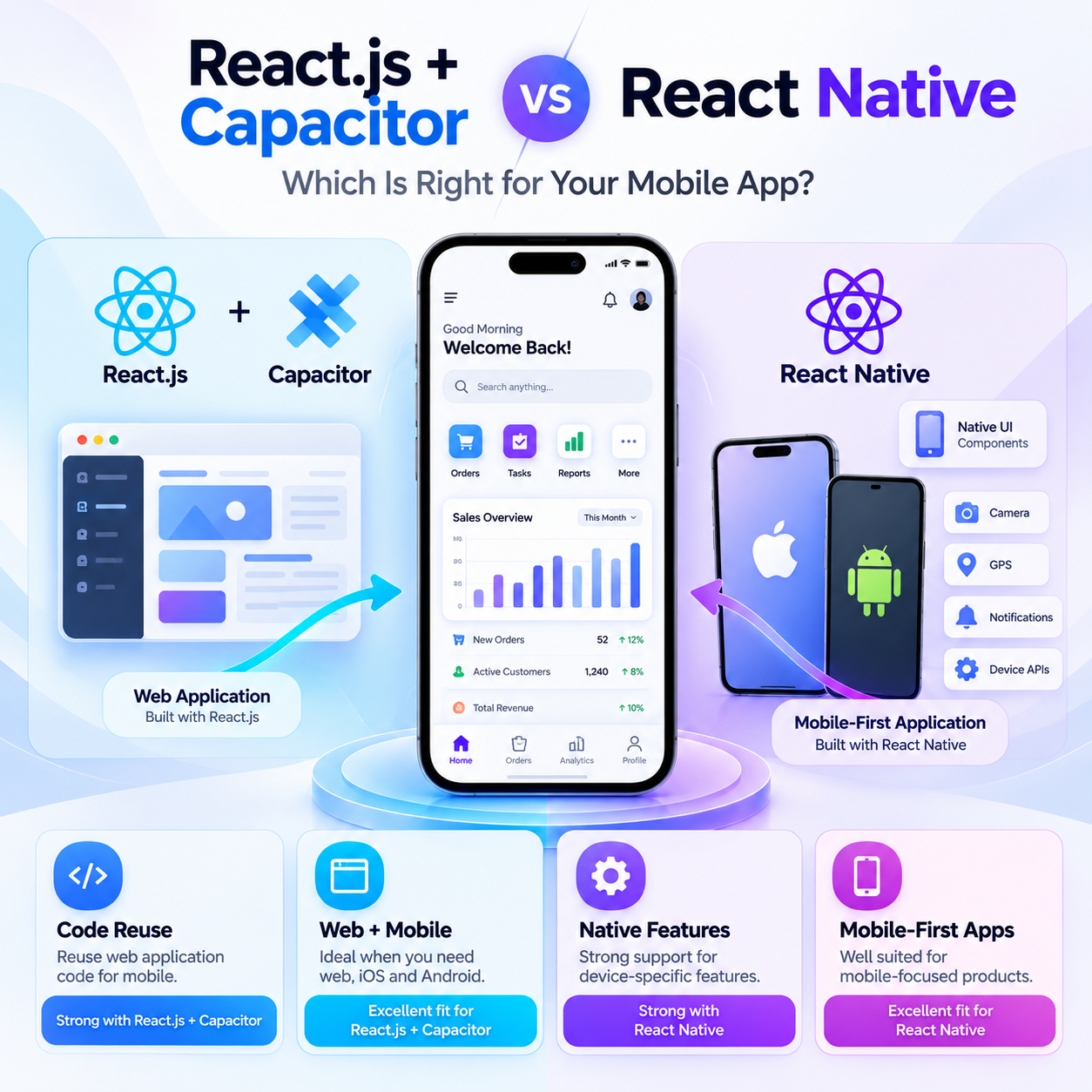
React.js + Capacitor vs React Native: Which Is Right for Your Mobile App?
Choosing the right technology is one of the most important decisions when planning a cross-platform mobile application.
For businesses targeting both iOS and Android users, two approaches often come into consideration: React.js with Capacitor and React Native.
Both can be used to build cross-platform mobile applications, but they take different approaches.
React.js + Capacitor can be particularly useful when a business already has a web application—or plans to build web and mobile experiences together—and wants to reuse a significant part of its web development effort.
React Native, on the other hand, is designed specifically for mobile application development and can be a strong choice for mobile-first products that require deeper native functionality.
So, which should you choose?
The answer depends on your existing technology, product requirements, device features, performance expectations, development strategy, and long-term roadmap.
This React.js + Capacitor vs React Native comparison looks at the differences from a practical business perspective.
What Is React.js + Capacitor?
React.js is widely used to create modern web applications and interactive user interfaces.
Capacitor provides a way to run web applications as native applications on platforms such as iOS and Android while allowing developers to access native device functionality through APIs and plugins.
The development approach can be simplified as:
React.js Web Application → Capacitor → iOS & Android Apps
Instead of creating completely independent web and mobile applications, businesses can potentially share a significant amount of application logic, interfaces, and development effort.
This makes React.js + Capacitor mobile app development particularly interesting for companies that already have a React-based web application or need to support web, iOS, and Android from a closely related codebase.
What Is React Native?
React Native is a framework designed specifically for cross-platform mobile app development.
Developers can use JavaScript and React concepts while creating interfaces that render using native platform components.
The approach can be represented as:
React Native Application → Native Components → iOS & Android
Because React Native is focused primarily on mobile development, it can be well suited to applications where the mobile experience is the central product and native device interaction plays an important role.
React.js + Capacitor vs React Native: Key Differences
Here is a practical comparison:
Consideration | React.js + Capacitor | React Native |
Development approach | Web-first / shared web-mobile approach | Mobile-first approach |
iOS & Android | Yes | Yes |
Existing React.js web app | Strong advantage | Additional mobile development usually required |
Web code reuse | High potential | More limited |
Native device access | Through Capacitor APIs/plugins | Strong native integration |
Mobile-specific UI | Good for many business applications | Strong |
Web + mobile strategy | Excellent fit | Primarily mobile-focused |
Business applications | Strong fit | Strong fit |
Highly native applications | Evaluate requirements carefully | Often a stronger fit |
Neither approach is automatically better.
The right choice depends on the type of application you are building.
When Does React.js + Capacitor Make More Sense?
1. You Already Have a React.js Web Application
This is one of the strongest reasons to consider Capacitor.
Suppose your business already operates a React.js customer portal, SaaS platform, internal application, or e-commerce solution.
You now want to offer the same core functionality through iOS and Android applications.
Instead of rebuilding the complete product using a separate mobile technology, Capacitor may allow your development team to reuse significant parts of the existing application.
The exact level of reuse depends on how the current application was designed, but it can provide a more efficient path from web application to mobile application.
2. You Need Web, iOS, and Android
Some businesses are not building only a mobile app.
They need a complete digital product that works across:
Web + iOS + Android
In this situation, React.js + Capacitor can provide an attractive architecture because the web and mobile experiences can share technology, components, business logic, and development resources.
This can simplify development and future maintenance compared with managing completely independent applications.
3. You Are Building a Business Application
Not every mobile application needs complex native functionality.
Many business applications primarily need:
- Authentication
- Dashboards
- Forms
- Customer information
- Product information
- Approvals
- Notifications
- Document access
- Reporting
- API integration
- ERP or CRM connectivity
For applications such as customer portals, employee apps, sales applications, field service solutions, and workflow systems, React.js + Capacitor can be a practical cross-platform development approach.
4. Code Reuse Is Important
Maintaining separate development efforts for web and mobile can increase complexity over time.
When code reuse is technically practical, React.js + Capacitor can help businesses maintain a closer relationship between their web and mobile products.
This may make future feature development, maintenance, and application updates more manageable.
When Does React Native Make More Sense?
1. You Are Building a Mobile-First Product
If the mobile application is the primary product rather than an extension of a web platform, React Native may be a stronger candidate.
For example, a startup building a product where nearly all customer interaction happens through mobile devices may benefit from a development framework designed specifically around mobile experiences.
2. Your App Relies Heavily on Native Device Features
Both approaches can access device functionality, but the level and complexity of native integration matter.
Applications may require:
- Advanced camera functionality
- Bluetooth communication
- Continuous location tracking
- Background processes
- Complex gestures
- Advanced animations
- Specialized hardware integrations
- Platform-specific functionality
When these capabilities form a major part of the product, React Native—or even native development in some cases—may deserve stronger consideration.
3. You Need a Highly Mobile-Specific Experience
Some products require extensive mobile-specific interactions and interfaces rather than adapting functionality shared with a web application.
React Native provides more direct control over native UI components and can therefore be well suited to applications where the mobile experience itself is the primary design focus.
React Native vs Capacitor: What About Performance?
Performance is often one of the first concerns when comparing React Native vs Capacitor.
However, businesses should avoid making the decision based only on broad claims that one technology is always faster than another.
For many applications such as:
- Customer portals
- Employee applications
- Business dashboards
- E-commerce applications
- Sales apps
- Field service applications
- Workflow systems
a well-designed React.js + Capacitor application can provide an effective mobile experience.
React Native may have an advantage when an application requires intensive native interactions, highly complex animations, or functionality that depends heavily on the mobile operating system.
Performance also depends on factors beyond the framework, including:
Application Architecture + API Performance + Data Handling + UI Design + Backend Infrastructure + Optimization
The actual requirements should therefore be evaluated before making a technology decision.
Which Option Is More Cost-Effective?
There is no universal answer because mobile app development cost depends more on project scope than the framework itself.
Cost can be influenced by:
- Number of features
- UI/UX complexity
- Backend development
- API requirements
- Third-party integrations
- Native functionality
- Testing
- Security
- Maintenance
However, an important difference appears when an existing React.js application is involved.
If significant parts of the existing web application can be reused, React.js + Capacitor may reduce the amount of duplicated development required to create mobile applications.
For a new mobile-first product with extensive native requirements, React Native may provide a more suitable development foundation.
Instead of asking:
Which technology is cheaper?
Ask:
Which technology allows us to build and maintain the product efficiently over its complete lifecycle?
What About Maintenance and Future Development?
A mobile application continues to evolve after launch.
Businesses need to consider:
- New features
- Bug fixes
- Security updates
- Operating system updates
- API changes
- Performance improvements
- Integration updates
- Device compatibility
If your company maintains both a React.js web application and mobile applications, using Capacitor can potentially simplify development by allowing more technology and code to be shared.
React Native also provides a strong long-term development model, particularly when mobile is the main product.
The better choice is the one that fits your product roadmap, technical requirements, and development strategy.
React.js + Capacitor vs React Native: Which Should You Choose?
A simple way to approach the decision is:
Consider React.js + Capacitor if:
- You already have a React.js web application
- You need web, iOS, and Android applications
- Code reuse is important
- You are building a business application
- Your application primarily relies on APIs and standard mobile functionality
- You want a closely connected web and mobile development strategy
Consider React Native if:
- Mobile is the primary product
- You are starting with a mobile-first strategy
- Native device functionality is central to the application
- You require highly customized mobile interactions
- The application has limited need to share UI code with a web platform
The final decision should always be based on the actual project requirements.
Questions to Ask Before Choosing Your Mobile App Technology
Before deciding between Capacitor and React Native, answer these questions:
- Do we already have a web application?
- Is our existing application built with React.js?
- Do we need web, iOS, and Android?
- How much native device functionality is required?
- Is the product web-first, mobile-first, or equally important across platforms?
- What existing APIs and business systems need to be integrated?
- How important is code reuse?
- How will the application evolve over the next few years?
Answering these questions provides a much stronger basis for technology selection than simply choosing whichever framework is currently more popular.
Why Choose 4devnet for Cross-Platform Mobile App Development?
At 4devnet, we believe technology selection should begin with the business requirements rather than the framework.
We evaluate the application’s users, functionality, existing systems, integrations, target platforms, device requirements, and future roadmap before recommending a development approach.
Our application development capabilities include:
- React.js development
- Capacitor mobile app development
- Cross-platform mobile app development
- Custom web and mobile applications
- iOS and Android applications
- API development and integration
- ERP and CRM integration
- Business and enterprise applications
- Application modernization
- Backend development
Whether you already have a React.js application that needs to be extended to mobile or are planning a completely new digital product, we can help you evaluate the right architecture and development strategy.
Planning a Cross-Platform Mobile App?
Choosing between React.js + Capacitor and React Native should not be based on technology trends alone.
For businesses with an existing React.js application or a requirement for web, iOS, and Android, React.js + Capacitor can offer significant advantages in code reuse and development efficiency.
For mobile-first applications with extensive native requirements, React Native may be a stronger option.
The best decision starts with understanding what you are building today and how the product needs to evolve tomorrow.
Planning a new mobile application or considering turning your existing web application into an iOS and Android app?
Talk to 4devnet about your requirements and get a development approach tailored to your product.