

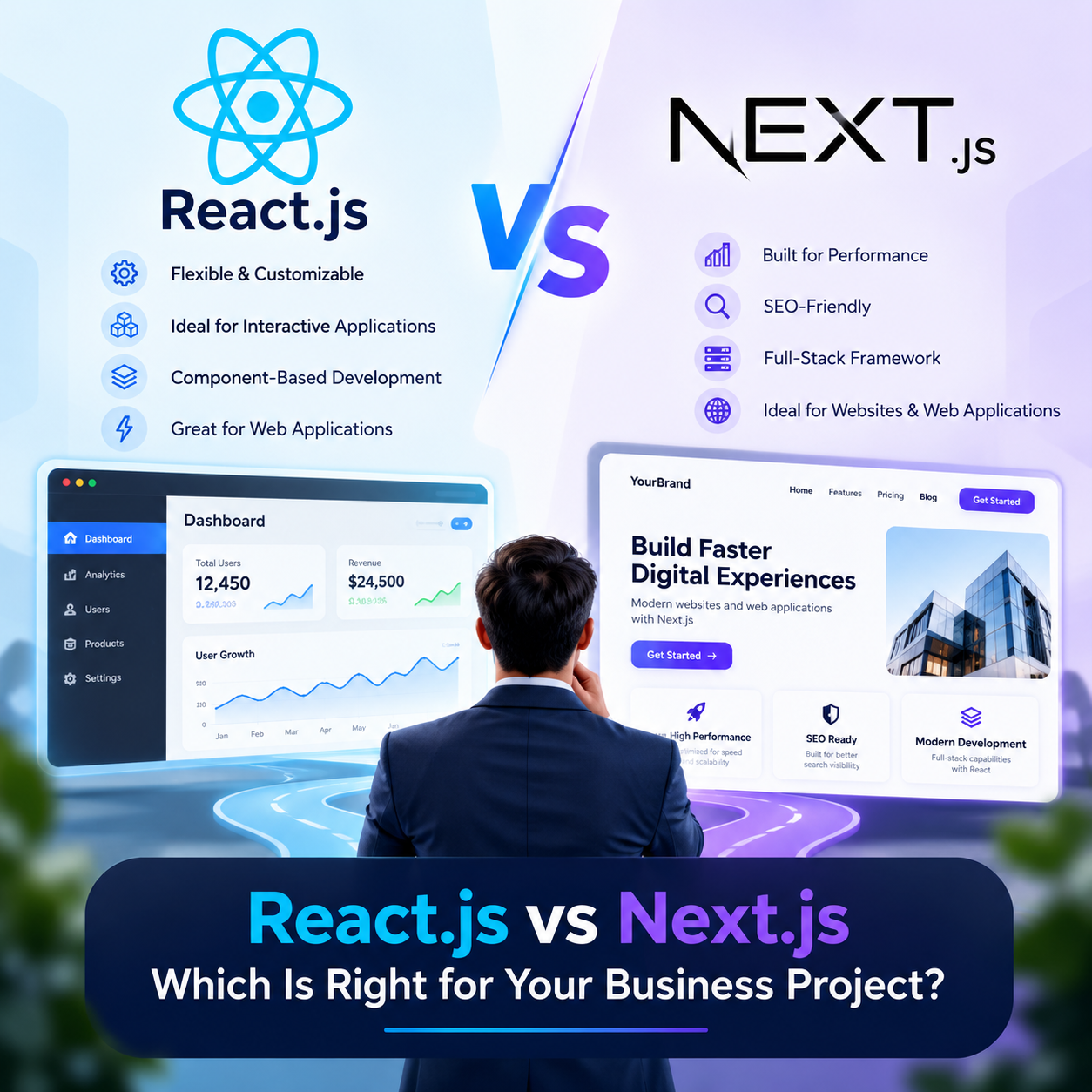
React.js vs Next.js: Which Is Right for Your Business Project?
Choosing the right technology for a new web application is an important business decision. The technology you select can influence development flexibility, website performance, SEO, scalability, maintenance, and the overall user experience.
Two technologies frequently considered for modern web development are React.js and Next.js.
But React.js and Next.js are not exactly competing technologies. Next.js is built on React.js and adds a broader framework around it, making the comparison more about which approach is better suited to your project requirements.
So, should your business choose React.js or Next.js?
The answer depends on what you are building, how users will access it, whether SEO is important, what integrations are required, and how you expect the application to grow.
This guide explains the differences between React.js and Next.js from a business and project-planning perspective, helping you make a more informed technology decision.
What Is React.js?
React.js is a JavaScript library for creating interactive user interfaces and modern web applications.
Its component-based architecture allows developers to build reusable interface elements and combine them into larger applications. This makes React.js particularly suitable for applications with dynamic interfaces, complex workflows, dashboards, portals, and user interactions.
Businesses commonly use React.js for:
- Custom web applications
- Business management applications
- Customer portals
- Employee portals
- SaaS applications
- Admin dashboards
- Reporting platforms
- E-commerce interfaces
- Booking and service platforms
- Interactive digital products
One of the major advantages of React.js is its flexibility. It can work with different backend technologies, APIs, databases, authentication systems, payment services, ERP platforms, and third-party applications.
For businesses that need a highly customized web application, React.js can provide a strong foundation for building the frontend around specific business requirements.
What Is Next.js?
Next.js is a React-based framework designed to help developers build modern websites and web applications.
Because it is built on React, developers can use familiar React concepts while benefiting from additional framework-level capabilities for routing, rendering, performance, and application development.
Next.js is commonly considered for:
- Business websites
- SEO-focused websites
- E-commerce platforms
- SaaS products
- Customer-facing applications
- Content-rich websites
- Marketing websites
- High-performance web applications
- Public-facing digital platforms
For businesses, one of the biggest advantages of Next.js is that it provides a more complete framework around React rather than requiring developers to assemble as many supporting pieces themselves.
React.js vs Next.js: What Is the Difference?
The simplest way to understand the relationship is:
React.js is a UI library, while Next.js is a framework built on React.
However, the practical difference is more important than the terminology.
Factor | React.js | Next.js |
Technology type | UI library | React-based framework |
Primary strength | Flexible application interfaces | Complete web application development |
Application structure | Flexible | More framework-driven |
Routing | Requires additional routing solution | Framework routing capabilities |
SEO requirements | Requires careful implementation | Strong support for SEO-oriented applications |
Rendering options | Primarily client-side by default | Multiple rendering approaches |
Performance capabilities | Depends on implementation | Framework-level optimization capabilities |
Best fit | Interactive custom applications | Websites and applications requiring broader web capabilities |
Flexibility | Very high | High, with more built-in conventions |
Neither technology is automatically better for every project.
The better choice is the one that fits your business objectives and technical requirements.
When Should You Choose React.js?
React.js can be an excellent option when your primary requirement is a customized and highly interactive web application.
1. You Are Building a Custom Business Application
Many business applications are used after a user has logged in and therefore don’t depend heavily on search engine traffic.
Examples include:
- CRM systems
- Employee portals
- Operations dashboards
- Internal workflow applications
- Customer management systems
- Reporting platforms
- Partner portals
- Business process applications
For these applications, functionality, usability, integrations, and maintainability may be more important than public search visibility.
React.js provides the flexibility to create interfaces around those specific requirements.
2. Your Application Has Complex User Interactions
React.js is well suited to applications where users frequently interact with data and interface components.
For example:
- Interactive dashboards
- Dynamic forms
- Data management systems
- Drag-and-drop workflows
- Reporting applications
- Real-time interfaces
- Multi-step business processes
Reusable components can also make it easier to maintain a consistent interface across a large application.
3. You Need Flexibility in Your Technology Architecture
Businesses often have existing technology systems that need to remain in place.
Your frontend may need to communicate with:
- Existing APIs
- ERP systems
- CRM systems
- Databases
- Payment gateways
- Authentication platforms
- Third-party services
React.js can be used as the frontend layer while the existing backend architecture remains in place.
4. You Already Have a React.js Application
If your business already has a React.js application, moving to another technology simply because it is newer or more popular may not make business sense.
Instead, evaluate:
- Current performance
- SEO requirements
- Application architecture
- Maintenance challenges
- Future requirements
- Development costs
A technology change should solve a real business or technical problem.
When Should You Choose Next.js?
Next.js can be particularly attractive when your project combines application functionality with public-facing web requirements.
1. SEO Is Important to Your Business
If search engines are an important source of visitors and potential customers, your web architecture needs to support your SEO strategy.
This can be especially relevant for:
- Business websites
- E-commerce websites
- Product websites
- Online marketplaces
- Content platforms
- Public SaaS websites
- Service-based businesses
Next.js provides rendering capabilities that can support search-friendly web experiences when the application is properly developed and optimized.
However, using Next.js alone does not guarantee better Google rankings.
SEO still depends on:
- Content quality
- Search intent
- Website structure
- Metadata
- Internal linking
- Page performance
- Mobile usability
- Technical SEO
- Backlinks and authority
2. Website Performance Is a Major Priority
For customer-facing websites, performance can influence user experience and conversions.
Next.js provides capabilities that can help development teams build performance-focused websites and applications.
This can be particularly useful when your project contains:
- Multiple public pages
- Product pages
- Landing pages
- Content-heavy sections
- Dynamic content
- E-commerce functionality
3. You Are Building a SaaS Product
SaaS products often have two different sides:
Public-facing website
and
Authenticated application
For example:
Website → Features → Pricing → Signup → Login → Dashboard
Next.js can be suitable for projects where these experiences need to work together within a broader application architecture.
4. You Want a Structured Framework
React provides significant flexibility, but that flexibility also means development teams need to make more architectural decisions.
Next.js provides established conventions and framework capabilities that can help organize larger web projects.
This can be useful for teams looking for a more structured development approach.
React.js vs Next.js for Different Business Requirements
There is no universal answer. The right choice changes depending on the project.
For a Corporate Website
Next.js may be a strong choice.
If SEO, page performance, content, lead generation, and public-facing experiences are important.
For an Internal Business Application
React.js may be a strong choice.
Especially when the application focuses on dashboards, workflows, forms, reporting, and employee operations.
For a Customer Portal
Both React.js and Next.js can work.
The decision should consider authentication, integrations, performance, SEO requirements, application architecture, and future plans.
For a SaaS Platform
Both technologies can be suitable.
Next.js can be particularly useful when the product combines a public marketing website with the application itself.
For E-commerce
Next.js can be a strong option.
SEO, product discovery, performance, and customer experience are often important requirements for e-commerce businesses.
For an Existing React Application
React.js may continue to be the right choice.
A migration to Next.js should be based on clear requirements rather than technology trends.
React.js vs Next.js for SEO: Which Is Better?
SEO is one of the most common reasons businesses consider Next.js.
A traditional React application may rely heavily on client-side rendering. Depending on how the application is built, this can require additional attention to SEO and content discoverability.
Next.js provides multiple rendering approaches that can be useful for SEO-oriented websites and applications.
However, it is important to understand that Next.js is not an SEO shortcut.
A technically well-built Next.js website can still perform poorly in search if it has:
- Thin content
- Poor keyword targeting
- Weak internal linking
- Slow pages
- Poor information architecture
- Duplicate content
- Poor mobile experience
- Weak backlinks
Therefore, the technology and SEO strategy should work together.
React.js vs Next.js for Performance
Performance depends on the complete application architecture rather than simply the framework or library.
Important factors include:
- Application architecture
- JavaScript bundle size
- API performance
- Image optimization
- Caching
- Database performance
- Hosting infrastructure
- Third-party scripts
- Code quality
- Rendering strategy
Next.js provides several capabilities that can help teams develop performance-focused applications.
React.js can also be used to build highly performant applications when the application is properly architected and optimized.
The important question is therefore not:
Which technology is automatically faster?
Instead, ask:
Which architecture will provide the performance required by this particular application?
Can React.js and Next.js Integrate With Existing Business Systems?
Yes.
Modern web applications rarely operate in isolation.
Your React.js or Next.js application may need to communicate with existing business systems such as:
- Odoo
- ERPNext
- CRM systems
- Payment gateways
- E-commerce platforms
- REST APIs
- GraphQL APIs
- Authentication services
- Databases
- Business intelligence platforms
- Third-party SaaS applications
For example, a business could build a modern React.js customer portal while connecting it to an existing ERP through APIs.
This allows the business to improve its customer experience without necessarily replacing the underlying business system.
Can React.js Be Used to Build Mobile Apps?
React.js is primarily a web development technology, but businesses can extend suitable web applications to mobile platforms using technologies such as Capacitor.
This approach can be useful for businesses that want to create iOS and Android applications while leveraging web development capabilities.
For example:
React.js web application
↓
Capacitor
↓
iOS + Android applications
However, not every mobile application should automatically use this approach.
The technology decision should consider:
- Required native device functionality
- Application complexity
- Performance expectations
- User experience
- Offline requirements
- Camera and location requirements
- Push notifications
- Existing application architecture
The right mobile technology should be selected according to the project’s requirements.
React.js vs Next.js: Which Costs More?
There is no standard price for React.js or Next.js development.
The cost of a project depends on its scope rather than the technology name alone.
Factors that influence development cost include:
- Number of features
- Number of screens
- UI/UX complexity
- Backend development
- API integrations
- User roles
- Authentication
- Payment functionality
- Third-party integrations
- Admin dashboard
- Testing requirements
- Deployment
- Maintenance and support
For example, a simple customer portal and a multi-tenant SaaS platform could both use React.js but have dramatically different development requirements.
For this reason, businesses should first define the project scope and then evaluate the appropriate technology and budget.
How to Decide Between React.js and Next.js
Before choosing a technology, consider these questions.
1. What Are You Building?
Is it a:
- Business website?
- Customer portal?
- SaaS application?
- Internal application?
- E-commerce platform?
- Marketplace?
- Dashboard?
- Digital product?
The type of product is one of the biggest factors in technology selection.
2. How Important Is SEO?
If Google and other search engines are important sources of customers, SEO should be considered from the beginning of the project.
3. Who Will Use the Application?
Consider whether the application is intended for:
- Employees
- Customers
- Partners
- Administrators
- The general public
4. What Systems Need to Be Integrated?
Prepare a list of the systems your application needs to communicate with.
For example:
ERP + CRM + Payment Gateway + APIs + Database + Analytics
This can significantly influence architecture and development decisions.
5. What Does Your Future Roadmap Look Like?
Don’t select a technology only for version one.
Consider whether you may eventually need:
- More users
- Additional modules
- Mobile applications
- New integrations
- Multiple languages
- Multiple locations
- Additional products
- Higher traffic
Your technology architecture should support your long-term business plans.
React.js vs Next.js: Which One Should Your Business Choose?
There is no universal winner.
React.js may be the right choice when you need a flexible foundation for a highly interactive custom web application.
Next.js may be the better choice when your project places greater emphasis on SEO, public-facing pages, performance, structured web development, or a combination of website and application experiences.
In many projects, the decision should not start with:
“Which technology is trending?”
It should start with:
“What does our business actually need this application to do?”
The right technology is the one that supports your users, business processes, integrations, performance requirements, budget, and future growth.
Build Your Next Web Application With the Right Technology
Choosing between React.js and Next.js is only the beginning of a successful web application project.
A strong development strategy starts with understanding your business requirements, user journeys, integrations, technical constraints, and long-term goals.
At 4devnet, we help businesses plan and develop custom web applications using modern technologies including React.js and Next.js.
Our development capabilities include:
- Custom web applications
- SaaS platforms
- Customer and partner portals
- Business dashboards
- E-commerce applications
- API and third-party integrations
- ERP-integrated applications
- Application modernization
- Cross-platform mobile applications
Whether you are starting a new digital product, modernizing an existing application, or evaluating React.js and Next.js for an upcoming project, our team can help you determine an appropriate technology approach.
Have a Web Application Project in Mind?
Let’s discuss your requirements and identify the right technology, architecture, and development approach for your business.
[Talk to Our Web Application Development Team]