

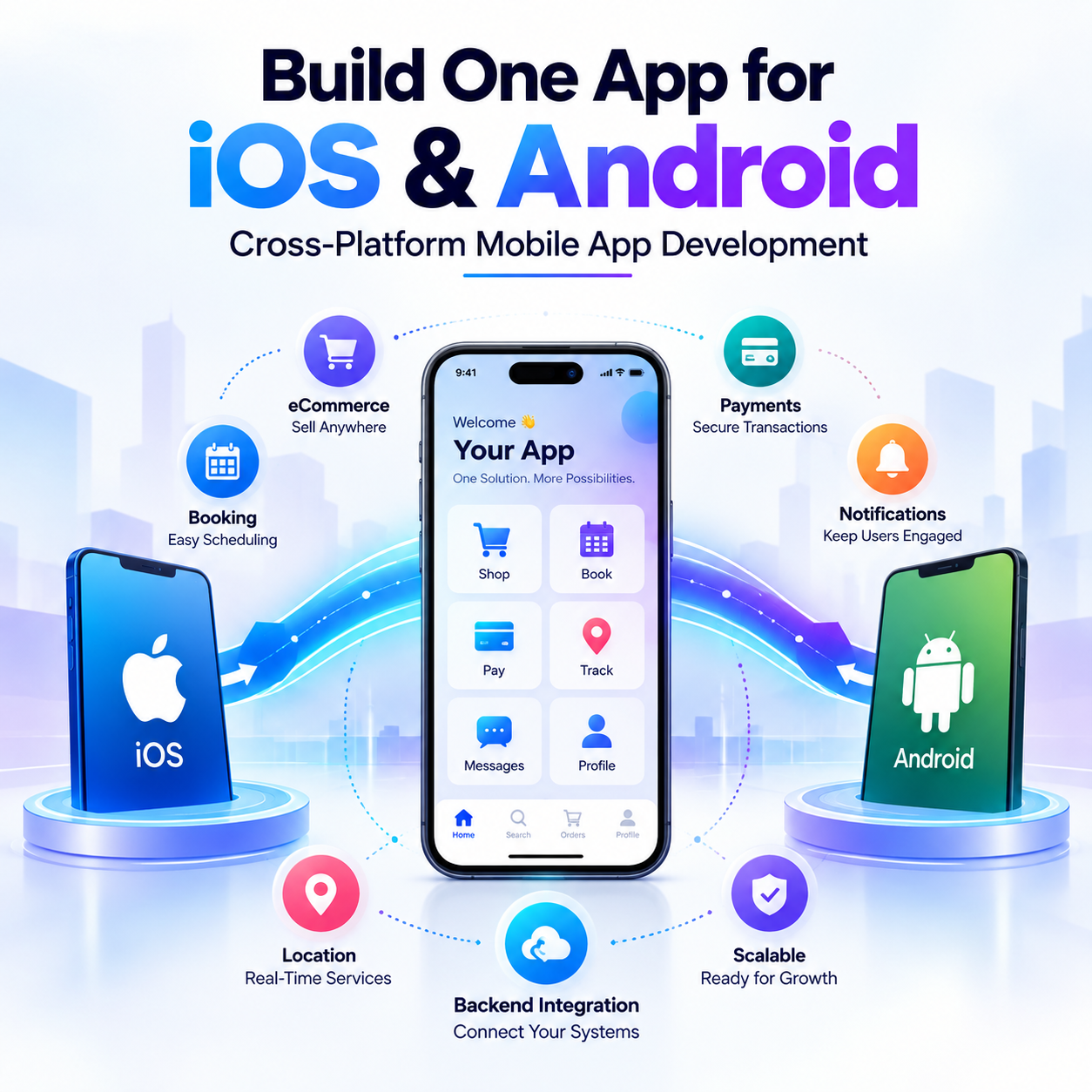
How to Build a Cross-Platform Mobile App for iOS and Android
Mobile applications have become an important part of how businesses engage with customers, deliver services, manage operations, and create digital products. Whether you are launching a startup, expanding an existing business, or modernising your digital platform, having an application available on both iOS and Android can help you reach a wider audience.
However, developing and maintaining two completely separate mobile applications can require significant time and resources.
This is where cross-platform mobile app development can be a practical alternative.
A cross-platform approach allows businesses to develop an application that can be deployed across iOS and Android while sharing a substantial part of the application code and functionality.
But building a successful cross-platform application involves more than choosing a development technology. You need a clear product strategy, user-friendly design, reliable backend architecture, proper testing, and a plan for ongoing improvements.
What Is Cross-Platform Mobile App Development?
Cross-platform mobile app development is an approach to creating mobile applications that work across multiple operating systems, primarily iOS and Android, using a shared development foundation.
With traditional native development, separate applications are generally developed for each platform. A cross-platform approach can reduce duplication by allowing developers to share much of the application logic, interface, and business functionality.
This can make development and maintenance more efficient while still allowing platform-specific requirements to be addressed where necessary.
Cross-platform development can be suitable for:
- Customer-facing mobile applications
- eCommerce apps
- Booking and appointment platforms
- Business management applications
- Employee apps
- Delivery and logistics applications
- Education and learning platforms
- Membership applications
- Service-based applications
- Startup MVPs
The best approach depends on the application’s functionality, users, performance requirements, integrations, and long-term objectives.
Why Do Businesses Choose Cross-Platform App Development?
Reach iOS and Android Users
One of the biggest reasons businesses consider cross-platform development is the ability to target users on both major mobile operating systems.
Instead of developing an iOS application first and building an Android version later, businesses can plan for both platforms from the beginning.
This can be particularly useful when your customers use a mixture of Apple and Android devices.
Reduce Duplicate Development Effort
Developing two independent applications can mean repeating work across many areas, including interface development, business logic, testing, bug fixing, and future updates.
A suitable cross-platform architecture can allow developers to reuse a significant portion of the application.
While platform-specific work may still be necessary, sharing common functionality can reduce duplicated effort and simplify the overall development process.
Make Future Updates Easier to Manage
Mobile applications are not finished when they are published.
Businesses may need to introduce new features, improve existing workflows, fix issues, support new operating-system versions, and respond to customer feedback.
Managing a shared development foundation can make these changes easier to coordinate across iOS and Android.
This can be particularly valuable for businesses that expect their application to evolve continuously.
Support Faster Product Launches
For startups and businesses validating a new product idea, getting an application to market can be a priority.
A cross-platform approach can allow a development team to work toward iOS and Android releases without treating them as two entirely independent projects.
This can be useful for MVP mobile app development, where the objective is to launch a focused first version, collect user feedback, and then expand the product based on real-world requirements.
How to Build a Cross-Platform Mobile Application
A successful mobile application begins with business requirements rather than technology selection.
Here is a practical development process.
1. Define the Purpose of the Application
Start by identifying the problem your application will solve.
Consider:
- Who are the target users?
- What problem does the application address?
- What should users be able to accomplish?
- How will the application support your business?
- Does it need to connect with existing software?
- What would make the first version successful?
Clear objectives help prevent unnecessary functionality from increasing development time and cost.
2. Identify the Features for the First Release
Once the business objective is established, determine which features are essential.
Depending on the application, these could include:
- User registration and authentication
- User profiles
- Product browsing
- Search and filters
- Shopping cart
- Online payments
- Booking and scheduling
- Push notifications
- Location services
- Document uploads
- Messaging
- Reports and dashboards
- Third-party integrations
It is usually better to prioritise essential functionality for the first release rather than attempting to build every possible feature immediately.
A focused MVP can help businesses validate the product before making larger investments.
3. Design the User Experience
A mobile application needs to be easy to understand and navigate.
Before development begins, plan the key user journeys and screen flows.
The design process should consider:
- Navigation
- Screen layouts
- Forms
- Buttons and interactions
- Error handling
- Loading states
- Accessibility
- Mobile screen sizes
- iOS and Android conventions
The application should maintain a consistent brand identity while respecting the usability expectations of each platform.
4. Select the Right Development Technology
Technology selection should be based on the application’s requirements rather than popularity.
For many business applications, technologies such as React.js and Capacitor can provide an effective approach to cross-platform development.
React.js can be used to create modern, component-based application interfaces, while Capacitor provides a way to package web-based application experiences for native mobile environments and access required device capabilities.
This approach can be particularly attractive for businesses that want to maintain a relationship between their web and mobile experiences.
However, applications with highly specialised device requirements or demanding platform-specific functionality may require a different architecture.
The important point is to evaluate the project first and choose the technology accordingly.
5. Plan the Backend and Integrations
A mobile application is rarely an isolated product.
Most business applications need to exchange information with backend systems and external services.
Depending on the project, integrations may include:
- CRM systems
- ERP platforms
- Payment gateways
- Databases
- Inventory systems
- Authentication services
- Booking platforms
- Maps and location services
- Analytics platforms
- Third-party APIs
A well-designed API layer can allow the mobile application to communicate securely with these systems.
This is especially useful for businesses that already have software in place and want to extend their existing systems to mobile users.
6. Develop the Application
Once the requirements, design, architecture, and integrations have been established, the development process can begin.
Development is typically divided into smaller features or modules.
The team may work on:
- Application structure
- User authentication
- Core business functionality
- UI components
- API integration
- Device features
- Notifications
- Security
- Error handling
Developing in stages allows the business to review progress and identify changes before the entire application is completed.
7. Test Across iOS and Android Devices
Cross-platform development does not eliminate the need for platform-specific testing.
The application should be tested on different devices and operating-system versions to identify differences in behaviour and performance.
Testing should cover:
- Functional workflows
- User interface
- Navigation
- Performance
- Screen sizes
- Device permissions
- Notifications
- Camera and location features
- Payment workflows
- Network conditions
- Security
- Application stability
Testing on real devices is particularly important because simulators cannot always reproduce real-world device behaviour.
8. Launch and Continuously Improve
After development and testing, the application can be prepared for release through the relevant app stores.
But launching the application is only the beginning of its lifecycle.
After release, businesses should monitor:
- User feedback
- Application crashes
- Performance
- Reviews and ratings
- Feature usage
- User retention
- Conversion rates
This information can help determine which improvements and features should be prioritised in future releases.
How Much Does Cross-Platform Mobile App Development Cost?
The cost of developing a mobile application varies significantly from project to project.
There is no fixed price because development effort depends on factors such as:
- Number and complexity of features
- UI/UX requirements
- Backend development
- Third-party integrations
- Payment functionality
- User authentication
- Admin functionality
- Security requirements
- Device-specific capabilities
- Testing requirements
- Post-launch support
A simple business application may require considerably less development effort than a marketplace, logistics platform, or enterprise application.
For an accurate estimate, businesses should first prepare a clear feature list and define the expected user journeys.
Cross-Platform vs Native App Development
A common question is whether a business should choose cross-platform or native mobile app development.
Cross-Platform Development
A cross-platform approach can be suitable when your priorities include:
- Supporting iOS and Android
- Efficient development
- Reusable application functionality
- Faster product launches
- Simplified maintenance
- Consistent business logic
Native Development
Native development may be more appropriate when the application depends heavily on platform-specific capabilities, specialised hardware features, or highly customised performance requirements.
There is no universal winner.
The right approach depends on the application, target audience, required features, budget, performance expectations, and future roadmap.
Common Challenges in Cross-Platform App Development
Cross-platform development can offer significant advantages, but businesses should also understand its challenges.
Platform Differences
iOS and Android have different interface conventions, device capabilities, and operating-system behaviours. A shared application still needs to provide an appropriate experience on both platforms.
Device Compatibility
There are many different Android devices and screen configurations, while Apple devices also vary by model and operating-system version.
Thorough testing is therefore essential.
Performance Requirements
Most business applications can be developed successfully using cross-platform approaches, but applications with extremely specialised performance requirements may require more platform-specific optimisation.
Third-Party Integrations
Some device features and external services may require additional configuration or native platform integration.
These requirements should be identified during the planning stage rather than discovered late in development.
Common Mistakes Businesses Should Avoid
Trying to Build Everything in Version One
Adding every possible feature can make an application expensive and slow to launch.
Start with the functionality that directly supports the primary business objective.
Designing for Developers Instead of Users
A technically sophisticated application is not necessarily a good application.
Navigation, workflows, accessibility, and ease of use should remain central to the design.
Ignoring Backend Architecture
The mobile interface is only one part of the solution. APIs, databases, authentication, integrations, and administration systems may be equally important.
Treating iOS and Android as Completely Identical
The core functionality can be shared, but the user experience should account for platform-specific expectations.
Forgetting Post-Launch Support
Operating systems, devices, APIs, and customer expectations change over time. Mobile applications require ongoing maintenance and improvement.
How to Choose a Cross-Platform Mobile App Development Company
The development partner you select can significantly influence the quality and long-term success of your application.
When evaluating a cross-platform mobile app development company, look for experience with:
- iOS and Android application development
- React.js development
- Capacitor or similar cross-platform technologies
- Mobile UI/UX
- API and backend integration
- Payment integrations
- Cloud services
- Application security
- Testing and quality assurance
- App Store and Google Play deployment
- Post-launch maintenance
More importantly, the development company should understand your business requirements.
A reliable technology partner should be able to explain why a particular development approach is appropriate for your project, rather than simply recommending a technology because it is popular.
Is Cross-Platform Development Right for Your Business?
Cross-platform mobile app development may be worth considering if you:
- Need an application for both iOS and Android
- Want to launch a new mobile product efficiently
- Are developing an MVP
- Want to extend an existing web application to mobile
- Need to connect a mobile application with business systems
- Want to reduce duplicated development effort
- Expect the application to evolve over time
If your application requires highly specialised platform-specific functionality, a native approach may be more appropriate.
A technical assessment before development can help you make the right decision.
Conclusion
Building applications for iOS and Android does not necessarily require two completely independent development projects.
A well-planned cross-platform mobile app development strategy can help businesses reach users across both platforms while sharing application functionality and reducing duplicated development work.
However, successful mobile development depends on much more than the development framework. Business objectives, user experience, backend architecture, integrations, security, testing, performance, and long-term maintenance all need to be considered.
Whether you are developing a startup MVP, launching a customer application, extending an existing web platform to mobile, or building a custom business solution, selecting the right development approach at the beginning can help reduce future complexity.
Planning an iOS and Android Mobile App?
If you are planning a new mobile application or want to extend an existing web application to iOS and Android, 4devnet can help you evaluate the requirements and select an appropriate development approach.
Discuss your mobile app project with 4devnet and explore a practical cross-platform solution for your business.