
Complete Equipment Rental Management Software: From Machine Deployment to Profitability
Managing an equipment rental business involves much more than knowing where your machines are. Rental companies need to manage customers, contracts, sites, machine deployment, operators, fuel, maintenance, spare parts, billing, receivables and profitability—often across multiple locations.
When these activities are handled through spreadsheets and disconnected systems, it becomes difficult to get a clear view of equipment availability, operating costs and profitability.
Equipment Rental Management Software brings these processes together on one centralized platform, helping businesses manage the complete rental lifecycle from quotation and contract management to machine deployment, maintenance, billing and profitability analysis.
What Is Equipment Rental Management Software?
Equipment Rental Management Software is a business management solution designed for companies that rent machinery, construction equipment and other assets.
It can connect the complete rental workflow:
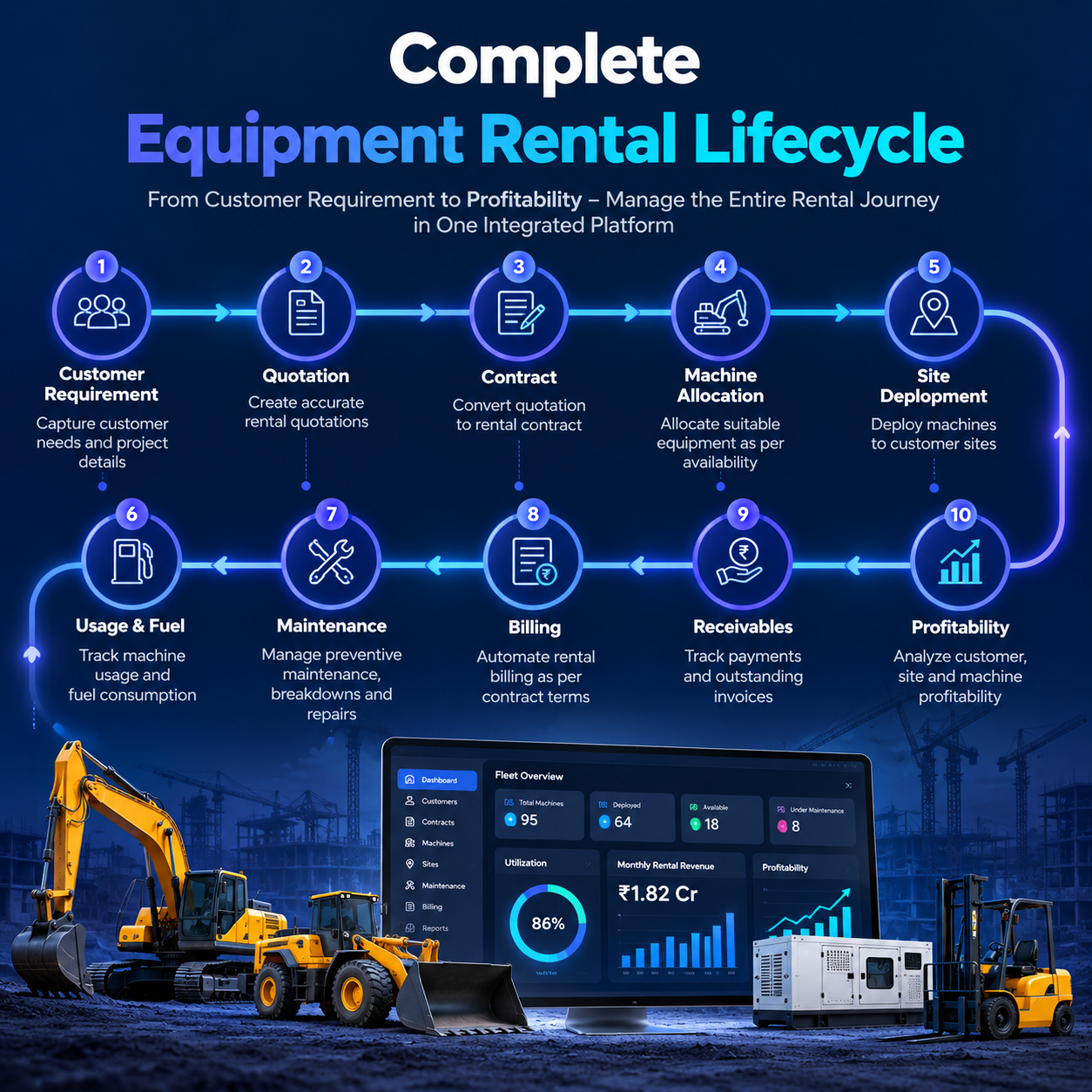
Customer Requirement → Quotation → Contract → Machine Allocation → Site Deployment → Usage → Maintenance → Billing → Receivables → Profitability
Key capabilities include:
- Machine master and machine-wise history
- Customer and site management
- Rental quotations and contracts
- Machine availability and deployment
- Equipment utilization tracking
- Operator allocation
- Fuel tracking
- Preventive maintenance
- Breakdown and repair management
- Spare-parts management
- Automated rental billing
- GST invoicing
- Receivables management
- Machine, customer and site profitability
- MIS dashboards
- Integration with HR, accounts, stores and manufacturing
Why Do Equipment Rental Businesses Need Rental Management Software?
As a rental fleet grows, managing equipment across multiple customers and sites becomes increasingly complex.
Management needs quick answers to questions such as:
- Which machines are available?
- Where is each machine deployed?
- Which contract is associated with a machine?
- How much has the machine been utilized?
- How much fuel has it consumed?
- When is maintenance due?
- What are the repair and spare-parts costs?
- How much has been billed?
- What is outstanding?
- Is the machine, customer or site profitable?
An integrated equipment rental ERP connects this information and provides a centralized view of operations.
1. Machine, Customer and Site Management
A centralized machine master can maintain important information such as:
- Machine ID, model and serial number
- Equipment category and capacity
- Current location
- Rental and deployment status
- Meter or operating hours
- Maintenance history
- Insurance and registration details
The system can connect:
Customer → Project → Site → Contract → Machine → Operator → Expenses → Billing
This makes it easier to track machines, contracts, costs and activities at customer and site level.
2. Rental Quotations and Contract Management
Rental software can simplify the complete process from quotation to contract.
Quotations can include:
- Equipment
- Rental period
- Rental rate
- Operator charges
- Transportation
- Fuel terms
- Taxes
- Payment conditions
Once approved, the quotation can be converted into a rental contract.
Contracts can define rental rates, billing frequency, rental periods, machine assignments, operator requirements and other commercial terms.
This reduces duplicate data entry and improves consistency between quotations, contracts and invoices.
3. Machine Deployment and Availability
Knowing whether a machine is available is critical for rental businesses.
Equipment can have different statuses such as:
Available | Reserved | Deployed | In Transit | Maintenance | Repair
A centralized availability view helps rental teams identify suitable machines before accepting new rental requirements.
It can also help reduce scheduling conflicts and improve fleet planning.
4. Equipment Utilization and Operator Tracking
Equipment utilization is an important indicator of rental fleet performance.
Software can track:
- Rental days
- Operating hours
- Idle time
- Maintenance downtime
- Breakdown downtime
- Utilization percentage
Equipment Utilization % = Utilized Time ÷ Available Time × 100
Businesses can use this information to identify underutilized equipment and make better decisions about deployment and fleet planning.
For machines supplied with operators, the system can also connect:
Machine + Operator + Customer + Site + Contract
5. Fuel, Maintenance and Breakdown Management
Fuel and maintenance can represent significant operating costs.
Rental management software can track fuel consumption by machine, site and operating period, helping businesses understand equipment operating costs.
Preventive maintenance can be scheduled based on:
- Operating hours
- Calendar intervals
- Equipment type
- Service history
When breakdowns occur, the system can record:
- Machine
- Site
- Problem
- Technician
- Repair activity
- Spare parts used
- Repair cost
- Downtime
This creates a complete machine-wise maintenance history.
6. Spare Parts Management
Maintenance operations depend on the availability of spare parts.
An integrated rental ERP can track:
- Spare-parts stock
- Parts received and issued
- Machine-wise consumption
- Purchase requirements
- Supplier information
- Spare-parts costs
This creates a clear connection between:
Machine → Maintenance → Spare Parts → Cost
7. Automated Rental Billing and GST Invoicing
Rental billing can become complicated when different contracts have different rates and billing cycles.
Equipment rental software can automate billing based on:
- Daily, weekly or monthly rental
- Hourly usage
- Operating hours
- Contract terms
- Operator charges
- Transportation
- Additional services
For Indian businesses, the system can also connect rental transactions with GST invoicing and accounting processes.
This can reduce manual calculations and improve billing accuracy.
8. Receivables Management
Generating invoices is only part of the rental process. Businesses also need visibility into collections.
A rental ERP can provide:
- Invoice value
- Due date
- Amount received
- Outstanding amount
- Overdue amount
- Customer payment history
This helps finance teams monitor receivables and follow up on overdue payments.
9. Machine, Customer and Site-Wise Profitability
Revenue alone does not show the true performance of rental operations.
A machine may generate significant rental revenue while also having high fuel, operator, maintenance and repair costs.
An integrated system can combine revenue and expenses to analyze:
Machine Profitability
Rental Revenue − Machine-Related Costs
Site Profitability
Site Revenue − Site-Related Costs
Customer Profitability
Customer Revenue − Customer-Related Costs
This gives management better visibility for pricing, contract evaluation and fleet planning.
10. MIS Dashboards for Equipment Rental Businesses
Management dashboards can bring important information together in one place.
Fleet
- Total machines
- Available machines
- Deployed machines
- Machines under maintenance
- Utilization
Rentals
- Active contracts
- Expiring contracts
- Rental revenue
- Upcoming billing
Maintenance
- Maintenance due
- Open breakdowns
- Repair jobs
- Downtime
- Maintenance costs
Finance
- Revenue
- Expenses
- Receivables
- Overdue invoices
- Profitability
This allows management to monitor the business without manually combining multiple reports.
11. Integration with HR, Accounts, Stores and Manufacturing
As the business grows, equipment rental operations may need to connect with other departments.
HR
- Employee records
- Operators
- Attendance
- Payroll
Accounts
- Invoicing
- GST
- Receivables
- Payments
- Expenses
Stores
- Spare parts
- Inventory
- Purchasing
- Stock movements
Manufacturing
- Bills of Materials
- Production
- Work orders
- Material planning
An integrated ERP approach creates a scalable technology foundation for future business growth.
Complete Equipment Rental Management Workflow
A modern rental management system can connect the entire lifecycle:
Customer Requirement
↓
Rental Quotation
↓
Contract
↓
Machine Allocation
↓
Site Deployment
↓
Operator & Usage Tracking
↓
Fuel & Maintenance
↓
Billing & GST
↓
Receivables
↓
Profitability & MIS
Instead of managing each activity separately, businesses can maintain connected information throughout the rental journey.
Key Benefits of Equipment Rental Management Software
An integrated solution can help rental businesses achieve:
Better Fleet Visibility
Know where machines are deployed and whether they are available.
Higher Equipment Utilization
Identify idle equipment and improve fleet planning.
Better Maintenance Control
Schedule preventive maintenance and manage breakdowns efficiently.
Improved Cost Tracking
Monitor fuel, operators, maintenance, repairs and spare parts.
Faster Billing
Automate rental billing based on contract terms.
Better Receivables Management
Track outstanding and overdue customer payments.
Clearer Profitability
Analyze profitability by machine, customer, site and contract.
Centralized MIS
Give management a consolidated view of operational and financial performance.
Equipment Rental Software vs. Spreadsheets
Many rental companies start with Excel, but managing growing fleets through spreadsheets can become difficult.
Requirement | Spreadsheets | Rental Management Software |
Machine tracking | Manual | Centralized |
Availability | Manual updates | Real-time status |
Contracts | Separate records | Structured |
Maintenance | Manual reminders | Scheduled |
Fuel tracking | Manual | Machine/site-wise |
Billing | Manual | Automated |
Receivables | Manual reports | Centralized |
Profitability | Difficult to consolidate | Machine/site/customer-wise |
MIS | Manual preparation | Dashboards |
Integration | Limited | Multi-department |
Who Can Benefit from Equipment Rental Software?
Equipment rental management software can support businesses managing:
- Construction equipment
- Excavators
- Cranes
- Loaders
- Forklifts
- Generators
- Compressors
- Earthmoving machinery
- Material handling equipment
- Industrial machinery
- Agricultural equipment
- Heavy machinery
Frequently Asked Questions
What is equipment rental management software?
It is a centralized system for managing equipment, customers, contracts, sites, deployment, utilization, maintenance, billing, receivables and profitability.
Can rental software track machine utilization?
Yes. It can track rental days, operating hours, idle time and downtime to help businesses monitor equipment utilization.
Can it manage preventive maintenance?
Yes. Maintenance schedules can be based on operating hours, dates or service intervals, with machine-wise maintenance history.
Can it track fuel consumption?
Yes. Fuel usage and costs can be recorded against machines and sites.
Can it manage spare parts?
Yes. Spare-parts inventory and consumption can be connected with maintenance and repair activities.
Can it calculate machine-wise profitability?
Yes. Rental revenue can be analyzed against fuel, operator, maintenance, repair, spare-parts and other machine-related costs.
Can it support GST invoicing?
A properly configured ERP can support GST-related invoicing and accounting workflows according to the business’s requirements.
Build a Connected Equipment Rental Business
Successful equipment rental management requires visibility across the entire business—not just the machines.
Machines + Customers + Contracts + Sites + Operators + Fuel + Maintenance + Spare Parts + Billing + Costs + Profitability
A centralized Equipment Rental Management Software solution can connect these processes and help businesses manage their rental operations more efficiently.
From machine deployment to profitability, an integrated system provides the visibility needed to improve fleet utilization, control costs, streamline billing and support scalable business growth.
Looking for Equipment Rental Management Software?
If your business manages construction machinery, heavy equipment or industrial assets across multiple customers and sites, a centralized rental management solution can help streamline your operations.
Manage machines, customers, contracts, deployment, utilization, operators, fuel, maintenance, spare parts, billing, GST, receivables, profitability and MIS through a connected business system.