

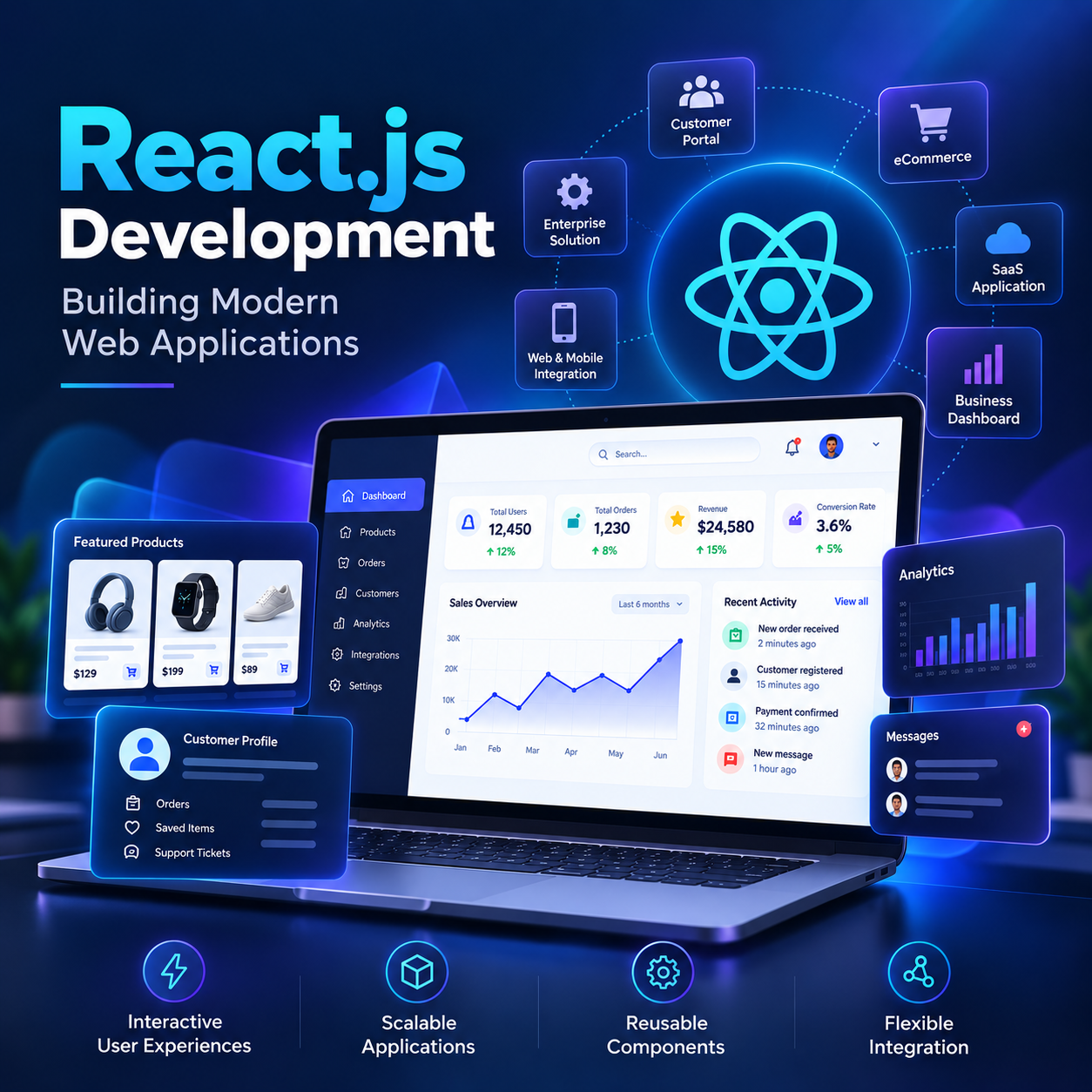
React.js Development: Why Businesses Choose React for Modern Web Applications
Businesses today rely on web applications for everything from customer portals and eCommerce platforms to internal business systems and SaaS products. As these applications become more interactive and feature-rich, businesses need development technologies that can deliver a smooth user experience without making future expansion unnecessarily difficult.
This is one of the reasons React.js development has become a popular choice for modern web applications.
React.js provides a flexible approach to building interactive interfaces and can support applications ranging from customer-facing platforms to complex enterprise solutions. But what makes it valuable for businesses, and when should you consider React.js for your next project?
What Makes React.js Suitable for Modern Web Applications?
React.js is an open-source JavaScript library for building user interfaces. Rather than treating a web application as one large interface, React.js allows developers to build it using smaller, reusable components.
This approach can be particularly useful for business applications where different sections of the application need to interact with users dynamically.
For example, an application could contain reusable components for:
- Navigation and menus
- Customer profiles
- Product listings
- Search and filtering
- Forms and workflows
- Dashboards
- Notifications
- Reports and data views
These components can be organised and reused throughout an application, helping development teams create consistent interfaces while making future changes easier to manage.
Why Are Businesses Choosing React.js Development?
1. Better Experiences for Application Users
A modern business application needs to feel responsive. Customers and employees do not want to wait for an entire page to reload every time they perform an action.
React.js is well suited to interactive interfaces where individual sections of the application need to respond to user actions.
For example, a customer could update their profile, filter products, check an order, or submit a form without disrupting the rest of the interface.
This makes React.js particularly useful for applications where user experience and interaction are important.
2. A Flexible Foundation for Growing Applications
Business requirements rarely remain unchanged.
An application that starts with ten features may eventually require additional workflows, integrations, dashboards, user roles, or reporting capabilities.
React.js supports a modular development approach, making it possible to organise application features into reusable components.
With a well-planned architecture, businesses can continue expanding their applications without having to rebuild the entire frontend whenever a new requirement appears.
This makes React.js a practical option for both new digital products and long-term business applications.
3. Reusable Components Can Improve Development Efficiency
One of React.js’s biggest strengths is its component-based approach.
Instead of creating every interface element from scratch, developers can create reusable components and use them in multiple areas of an application.
Consider an eCommerce application with hundreds of products. Rather than separately designing the interface for every product, developers can create a reusable product component and populate it with different information.
The same principle can be applied to forms, buttons, navigation elements, dashboards, cards, tables, and other interface elements.
This can make the development process more structured and simplify future maintenance.
4. Suitable for a Wide Range of Business Solutions
React.js is not restricted to a particular industry or application type.
Businesses can use React.js development for solutions such as:
- Customer portals
- Business management applications
- eCommerce platforms
- SaaS applications
- Booking and reservation systems
- CRM interfaces
- Employee portals
- Learning platforms
- Reporting dashboards
- Healthcare applications
- Logistics platforms
- Internal enterprise applications
The technology can therefore be adapted to different business models and application requirements.
5. Works With Different Backend Technologies
A business does not necessarily need to replace its existing backend systems to use React.js.
React.js can communicate with backend applications through APIs, allowing the frontend and backend to operate as separate parts of a larger application architecture.
This means React.js applications can work with backend technologies such as:
- .NET
- Node.js
- Python
- Java
- PHP
- Cloud-based services
- REST APIs
- GraphQL APIs
This flexibility can be especially valuable for businesses that already have established backend systems but want to modernise their user interface.
6. Strong Ecosystem and Long-Term Development Potential
Selecting a technology for a business application is a long-term decision.
The application may need regular improvements, security updates, integrations, performance optimisation, and new functionality after its initial launch.
React.js has a large ecosystem and developer community, which provides businesses with access to established development tools, libraries, frameworks, and resources.
This can make React.js a practical choice for organisations that expect their applications to evolve over several years rather than being developed as a short-term project.
React.js and Modern Business Applications
The value of React.js becomes more apparent when looking at the types of problems businesses need to solve.
Imagine a company that wants to provide customers with an online portal.
Customers may need to:
- View their account information
- Check previous orders
- Download documents
- Submit service requests
- Track transactions
- Update their details
- Communicate with the company
Such an application requires more than a collection of static web pages. It needs an interactive interface that can handle multiple workflows and respond to user actions.
A React.js-based application can provide the frontend foundation for this type of experience while connecting with the company’s existing backend systems and APIs.
The same principle applies to dashboards, SaaS platforms, eCommerce applications, and internal business systems.
React.js vs Traditional Website Development
React.js is not necessarily required for every website.
A simple informational website with a few pages may not need the complexity of a modern JavaScript application.
React.js becomes more relevant when the project requires significant interaction, such as:
- Complex user workflows
- Personalised dashboards
- Dynamic data
- Customer accounts
- Advanced search and filtering
- Real-time updates
- Interactive forms
- Multiple user roles
- Integration with business systems
For these types of projects, a React.js-based frontend can provide a more flexible foundation.
The right technology should ultimately be selected according to the project’s business requirements rather than simply following technology trends.
React.js and Next.js: What’s the Difference?
Businesses evaluating React.js development will often come across Next.js.
React.js provides the core foundation for building user interfaces, while Next.js is a framework built around React that adds capabilities useful for developing complete web applications.
Next.js can be particularly useful when a project requires capabilities such as improved search engine visibility, server-side rendering, routing, and structured application development.
The choice between using React.js directly or using a React-based framework such as Next.js depends on the application’s requirements.
For businesses, the more important question is not simply which technology is more popular, but which architecture is appropriate for the application they are planning to build.
When Should You Consider React.js Development?
React.js may be a good fit if your business is:
- Developing a new custom web application
- Modernising an existing application
- Building a SaaS product
- Creating an eCommerce platform
- Developing a customer or employee portal
- Building an interactive dashboard
- Connecting a new frontend to existing business systems
- Creating a scalable digital product
- Replacing an outdated or difficult-to-maintain frontend
Before starting development, it is worth evaluating the application’s expected users, features, integrations, performance requirements, security needs, and future growth.
How to Choose a React.js Development Company
The technology alone does not determine whether a web application will be successful. The development partner you choose can have an equally important impact.
When evaluating a React.js development company, look beyond the number of developers or years of experience. Consider whether the company understands business requirements and can manage the complete development lifecycle.
Important areas to evaluate include:
Business Understanding
The development team should understand what the application is supposed to achieve for your business—not simply translate a list of technical requirements into code.
Application Architecture
A scalable architecture can make it easier to introduce new features and integrations as your business grows.
UI and UX
The application should be easy to navigate and designed around the needs of its users.
Integration Capabilities
Your application may need to connect with CRMs, ERPs, payment gateways, third-party APIs, databases, or other business systems.
Testing and Quality
Proper testing is important for identifying usability, performance, compatibility, and functional issues before the application reaches users.
Long-Term Support
Web applications require ongoing maintenance. Your development partner should be able to support enhancements, troubleshooting, upgrades, and future development.
Final Thoughts
React.js has become a widely used technology for businesses developing modern web applications because it combines flexibility, reusable components, interactive user experiences, and a strong development ecosystem.
However, choosing React.js should not be based solely on its popularity.
The most successful projects begin with a clear understanding of the business problem, user requirements, application architecture, integrations, and long-term goals.
Whether you are planning a customer portal, SaaS platform, eCommerce application, internal business system, or another custom web solution, React.js development can provide a flexible foundation for building and scaling your application.
Planning a React.js Web Application?
If you have an idea for a new web application or want to modernise an existing application, the right development approach can help you reduce future limitations and create a better experience for your users.
Talk to 4devnet about your React.js development requirements and explore the right approach for your business application.