

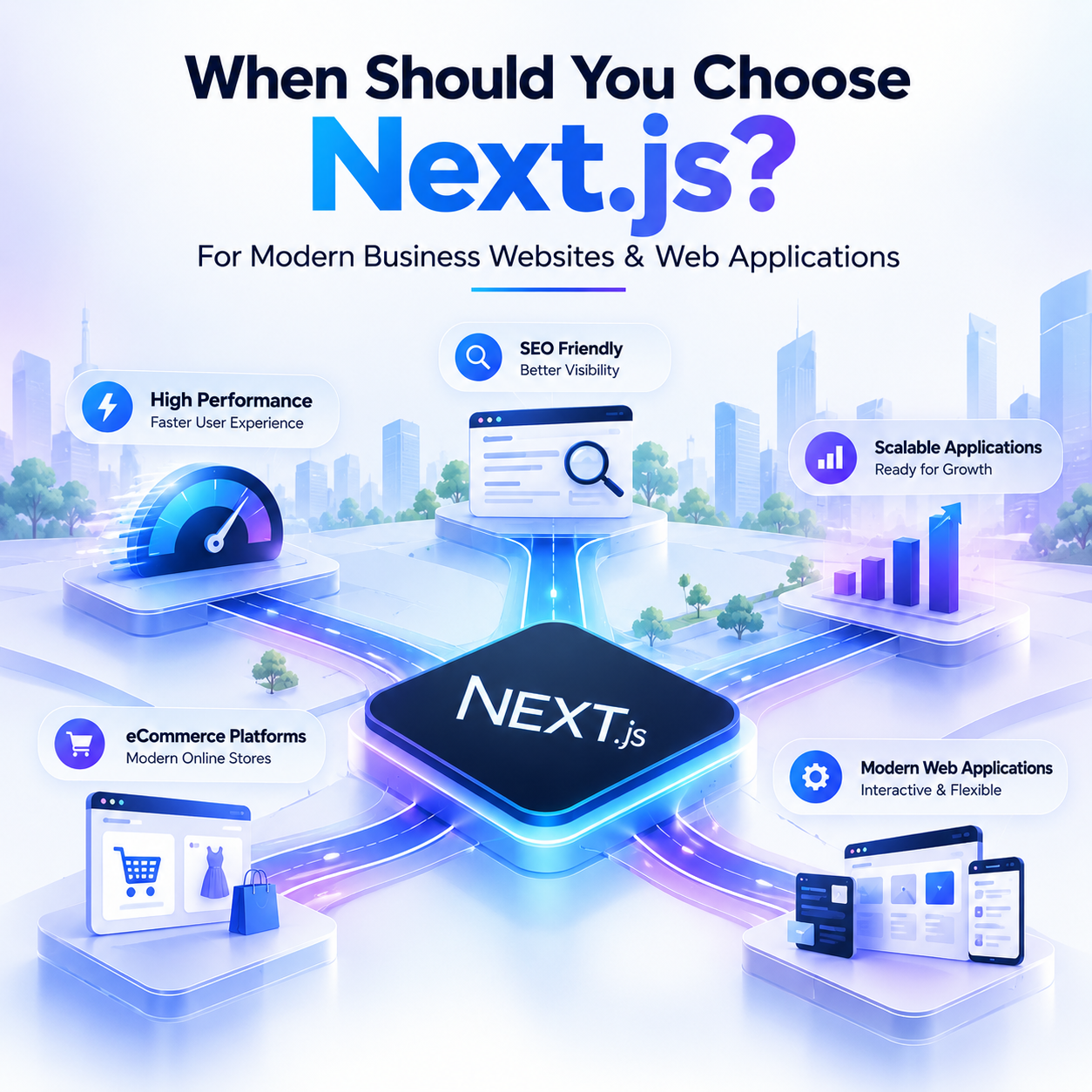
When Should You Choose Next.js for Your Business Website or Web Application?
Choosing the right technology for a business website or web application is an important decision. The technology you select can influence website performance, search visibility, user experience, development flexibility, and how easily your digital platform can grow in the future.
For businesses looking beyond a basic website, Next.js has become an increasingly popular option for building modern digital experiences. It combines the flexibility of React with features designed to support high-performing websites and web applications.
But does every business need Next.js?
Not necessarily.
The right choice depends on what you want to build, how users will interact with it, your SEO requirements, the complexity of your application, and your plans for future growth.
What Is Next.js?
Next.js is a web development framework built on React. It provides developers with a structured environment for creating modern websites and web applications while adding capabilities that go beyond basic frontend development.
It can support different approaches to rendering and content delivery, allowing developers to select an architecture based on the requirements of a particular project.
For businesses, this flexibility can be useful when building websites that need to combine strong performance, search engine visibility, interactive functionality, and scalability.
Next.js can be used for corporate websites, eCommerce platforms, SaaS products, customer portals, marketplaces, dashboards, and other custom web applications.
When Is Next.js a Good Choice for Your Business?
1. Your Website Needs Strong SEO and Organic Visibility
For many businesses, a website is more than an online brochure. It is an important channel for generating leads, attracting customers, and building brand visibility.
If organic search is an important part of your marketing strategy, the technology behind your website matters.
Next.js provides features that can help developers create search-engine-friendly websites and applications. Depending on the architecture, content can be made available to search engines efficiently while maintaining a modern user experience.
This makes Next.js web development worth considering for businesses that depend on:
- Organic search traffic
- Content marketing
- Product search visibility
- Local SEO
- Lead generation
- eCommerce traffic
However, technology alone does not guarantee better rankings. Content quality, technical SEO, website structure, backlinks, performance, and overall SEO strategy remain important.
2. Website Speed and User Experience Are Important
Visitors expect websites to load quickly and respond smoothly, particularly when browsing from mobile devices.
Performance becomes even more important for businesses operating competitive websites where users can easily move to another provider.
Next.js gives development teams several options for controlling how content is generated and delivered. This can help create websites that balance dynamic functionality with efficient content delivery.
For example, a business website may have fast-loading service pages while still providing interactive features such as calculators, forms, product filters, or customer portals.
For businesses investing heavily in their online presence, this combination of performance and functionality can be valuable.
3. You Are Building More Than a Simple Website
A basic company website may only require pages such as:
- Home
- About
- Services
- Contact
- Blog
If that is all you need, a simpler development approach may be sufficient.
The situation changes when your website needs application-like functionality.
For example, you may require:
- Customer accounts
- Advanced search
- Product filtering
- Online bookings
- Personalised dashboards
- Interactive forms
- Payment functionality
- Third-party integrations
- Real-time information
- Multiple user roles
When a website starts becoming an application, Next.js development can provide a structured foundation for building these experiences.
4. You Expect Your Web Application to Grow
Business applications rarely remain unchanged after launch.
A platform that starts with a few core features may eventually need additional modules, integrations, reports, user roles, or automated workflows.
If you already know that your application will expand, it is important to choose an architecture that can accommodate future requirements.
Next.js can be suitable for projects where scalability is an important consideration.
With a properly planned architecture, businesses can add functionality over time without treating every new feature as a completely separate development project.
This is particularly relevant for:
- SaaS platforms
- Customer portals
- B2B platforms
- Marketplaces
- eCommerce applications
- Enterprise web applications
5. You Need Both Content and Application Functionality
Some business projects are neither traditional websites nor purely software applications.
Consider an eCommerce platform.
It may need highly discoverable product pages for search engines while also providing:
- Customer registration
- Product search
- Filters
- Shopping carts
- Checkout
- Order management
- Customer accounts
- Payment integration
A similar situation can occur with a business that has a marketing website alongside a customer portal.
Next.js can be useful for these types of projects because it allows developers to build content-driven pages and interactive application functionality within the same overall ecosystem.
6. You Are Developing an eCommerce Platform
Online stores need to balance several requirements at the same time.
Product pages need to be discoverable. Pages should provide a good browsing experience. Customers need smooth interactions. And the platform needs to connect with services such as payments, inventory, shipping, analytics, and customer management.
A modern Next.js eCommerce development approach can provide a flexible frontend foundation while connecting to the required backend and third-party services.
This can be particularly useful for businesses that need a customised shopping experience rather than relying entirely on a standard template.
7. You Want to Modernise an Existing Web Platform
You do not always need to start from zero.
A business may already have a website or web application that works but has problems such as:
- Slow performance
- Difficult maintenance
- Outdated user experience
- Limited scalability
- Poor mobile experience
- Difficult integration with modern services
- Technical limitations when adding new features
In such cases, a gradual modernisation strategy may be more practical than completely rebuilding the business from scratch.
A Next.js-based frontend can be considered as part of a broader application modernisation project, particularly when existing backend systems and APIs can continue to be used.
Can Next.js Work With Your Existing Business Systems?
One common concern businesses have when adopting a new frontend technology is whether their existing systems need to be replaced.
In many cases, they do not.
A Next.js application can communicate with backend systems through APIs. This means the frontend can potentially connect with existing:
- ERP systems
- CRM platforms
- Databases
- Payment gateways
- Inventory systems
- Authentication services
- Business applications
- Third-party APIs
This approach can allow businesses to improve their digital experience while retaining valuable systems that are already part of their operations.
For example, a company could develop a modern customer-facing portal using Next.js while continuing to use its existing ERP or CRM in the background.
Next.js vs React.js: What Should a Business Choose?
Businesses researching modern web development often come across both React.js and Next.js.
React.js is a JavaScript library primarily focused on building user interfaces. Next.js is a framework built around React that provides additional capabilities for developing complete web applications.
A simplified way to look at it is:
React.js: A foundation for building interactive user interfaces.
Next.js: A React-based framework for developing modern websites and web applications with additional application and rendering capabilities.
Neither option is universally better.
For a project where you need a highly structured application, strong SEO considerations, flexible rendering options, and room for future expansion, Next.js may be a suitable choice.
When Might Next.js Be More Than You Need?
Choosing a powerful framework does not automatically make a project better.
If your business only needs a small informational website with limited functionality, introducing a more sophisticated application architecture may add unnecessary complexity.
For example, a simple website with a few static pages and a contact form may not require Next.js.
The better approach is to evaluate:
- Business objectives
- Website functionality
- Expected traffic
- SEO requirements
- Integration requirements
- Performance expectations
- Future expansion
- Development and maintenance needs
The technology should support the business strategy—not dictate it.
Is Next.js Suitable for Startups?
Next.js can also be considered by startups building digital products.
Startups often need to launch quickly while keeping enough flexibility to adapt when their product gains users.
A Next.js application can provide a foundation for developing an MVP and gradually adding features as the business validates its idea.
It can be suitable for products such as:
- SaaS platforms
- Online marketplaces
- Booking platforms
- Customer portals
- Subscription applications
- Business management platforms
The key is to avoid overengineering the initial product. A good development team should balance the startup’s immediate needs with its expected growth.
How to Choose a Next.js Development Company
Selecting the right technology is only one part of the project. The development partner you choose can have a major impact on the quality and long-term maintainability of your application.
When evaluating a Next.js development company, consider its experience with:
- Custom web application development
- Responsive design and user experience
- Technical SEO
- API and third-party integrations
- Database-driven applications
- Performance optimisation
- Security
- Testing and quality assurance
- Cloud deployment
- Application maintenance and support
It is also important to choose a team that understands your business requirements.
A good development partner should first understand what you want to achieve, then recommend the architecture and technology that best fits the project.
Key Signs That Your Business Should Consider Next.js
Next.js may be a strong option if your project requires several of the following:
- High-performing web pages
- Strong organic search visibility
- Interactive user experiences
- Custom application functionality
- eCommerce capabilities
- Customer or employee portals
- API integrations
- A scalable application architecture
- A modernisation of an existing platform
- A combination of content and application features
If most of these requirements apply to your project, it may be worth discussing Next.js with an experienced development team.
Conclusion
Next.js is not simply another frontend technology. It provides a flexible foundation for businesses that need modern websites and web applications combining performance, SEO, interactive functionality, and scalability.
It can be particularly valuable for eCommerce platforms, SaaS products, customer portals, business websites, marketplaces, and applications that are expected to grow over time.
However, the best technology choice depends on your specific requirements.
A successful project starts by understanding the business objectives, target users, functionality, integrations, performance expectations, and long-term roadmap. Once these factors are clear, your development team can determine whether Next.js is the right fit.
Planning a Next.js Website or Web Application?
Whether you are starting a new digital platform, developing a custom web application, or modernising an existing website, the right technology and development approach can make a significant difference.
Talk to 4devnet about your Next.js development requirements and explore how we can build a modern, scalable web solution for your business.